


 Kix Logo PNG
The Kix logo symbolizes simplicity and the everyday nature of the breakfast cereal brand. Its clear, concise design emphasizes family orientation and consumer trust, earned through simple ingredients and proven quality.
General Mills introduced Kix in 1937 as a corn-based breakfast cereal built around a new puffing process. Engineer Thomas James developed a pressure method that produced light, crisp corn pieces that held their texture in milk longer than many pressed cereals. The same basic technology later enabled other products, including Cheerios and Trix.
Early promotion relied on radio, with Kix advertised through The Lone Ranger, a popular children’s program of the period. The brand used premiums and collectible inserts to encourage repeat purchases while competing with established cereals such as Kellogg’s Corn Flakes and Rice Krispies. In the 1950s, advertising shifted toward television and presented Kix as a breakfast for active children.
A major marketing change came in 1978 with the slogan “Kid-tested, Mother-approved.” It remained tied to the cereal for about four decades. It addressed two audiences at once: children interested in taste and parents focused on nutrition. During the late 1980s, advertising placed greater emphasis on lower sugar, while Berry Berry Kix introduced a fruit-flavored variation.
Honey Kix joined the range in 2009, adding a sweeter option while keeping the core cereal format. In 2018, the slogan changed from “Mother-approved” to “Parent-approved,” reflecting shifts in how advertising represented parental roles while retaining the familiar wording associated with Kix.
Meaning and History
What is Kix?
It is a popular U.S.-based corn-based cereal brand recognized for its minimal ingredient list. The cereal consists of small golden balls with a natural, lightly sweet flavor and no sugary coating. Positioned as a breakfast option meeting both parental standards for nutrition and children’s preferences, flavors include classic, honey, and berry varieties. The cereal’s firm structure retains crunchiness in milk.
1937 – 1949
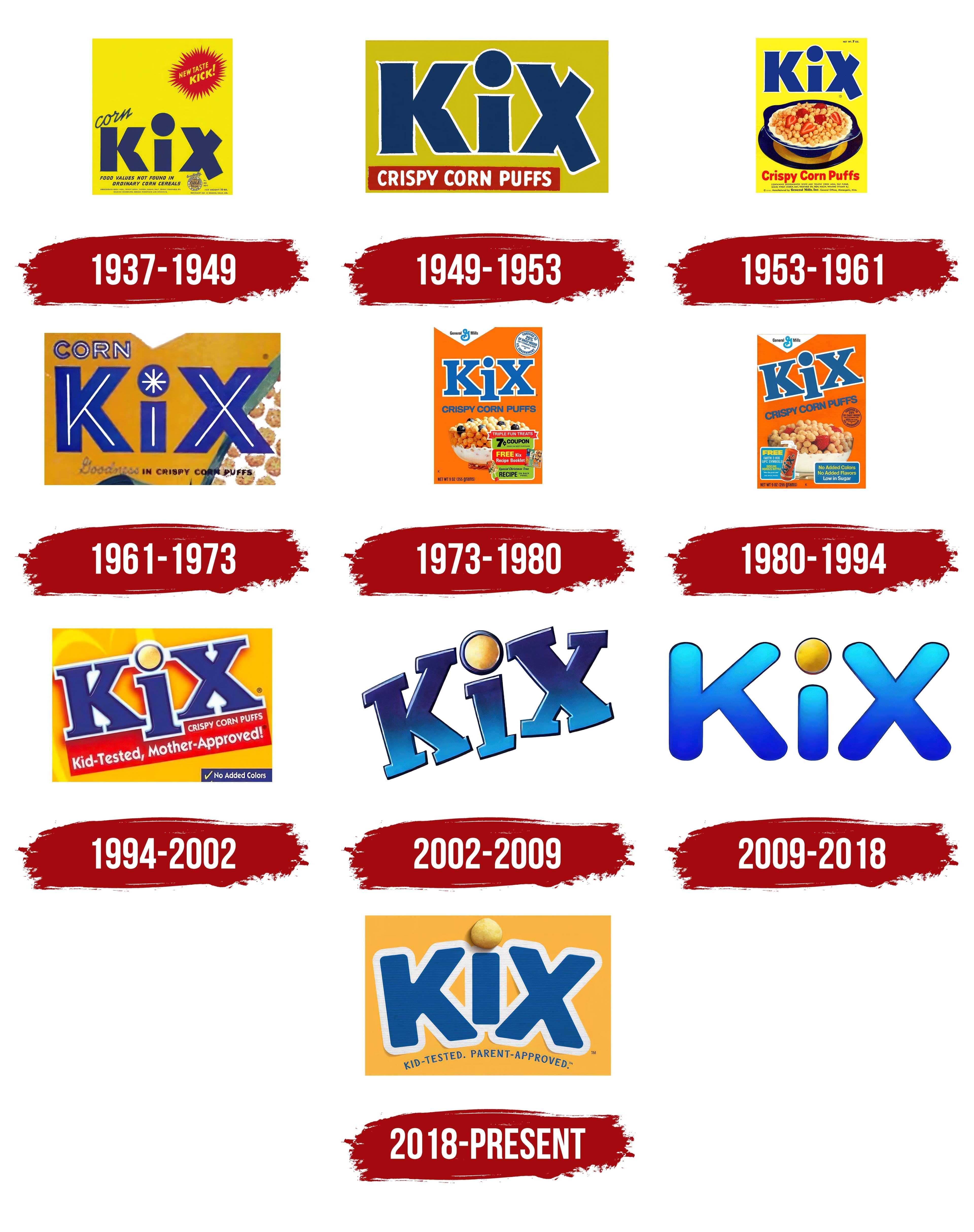
The introduction of a new cereal production technology coincided with Kix’s first appearance in 1937. General Mills introduced the puffed corn method, based on treating grain with pressure and heat in “puffing gun” machines. The product acquired a light structure, which distinguished it from competitors and formed the foundation of the brand’s communication.
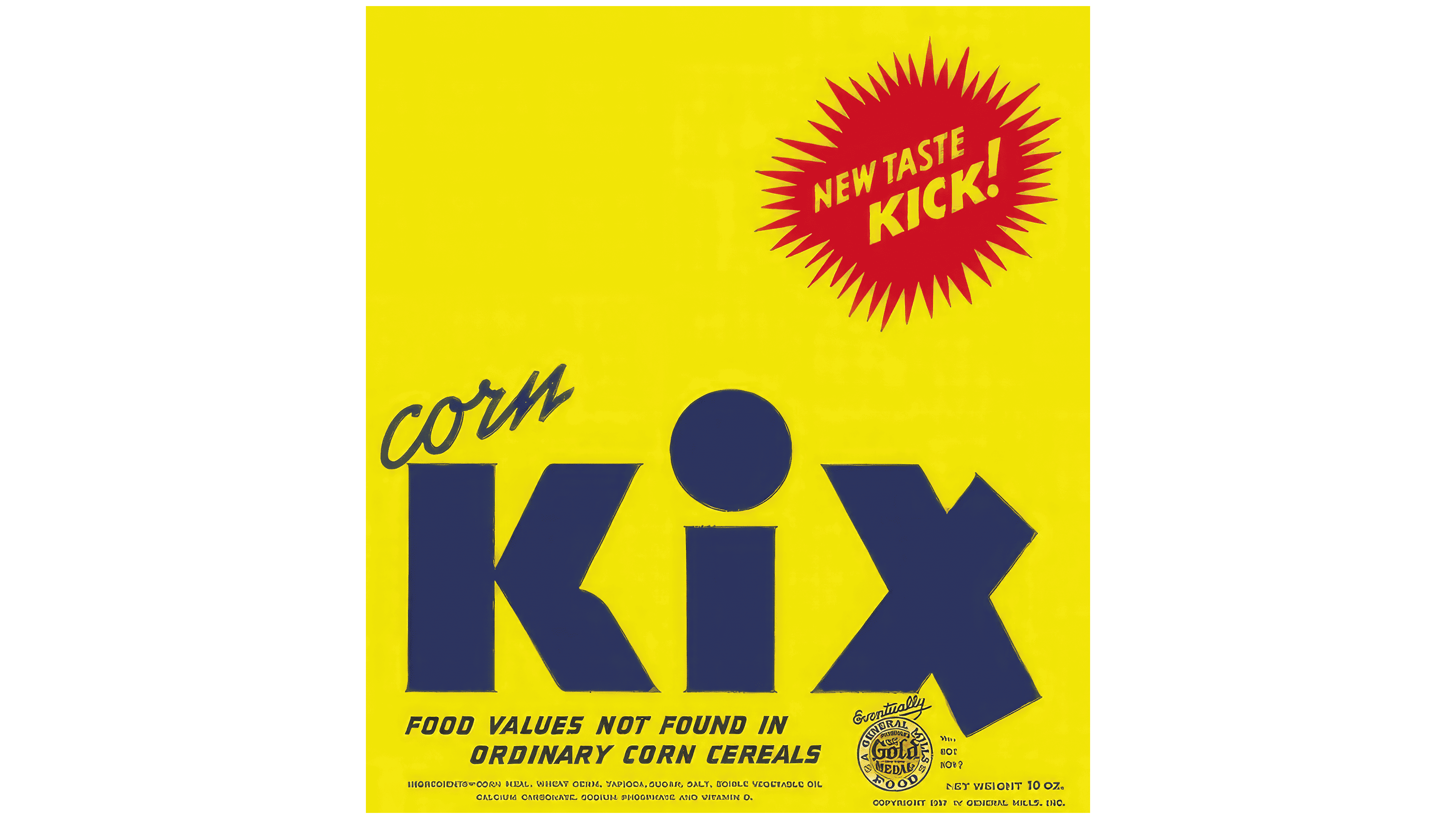
The visual concept was built on strong color contrast and clear structure. On a rich yellow background was a large blue inscription, “Kix.” The typeface was massive, sans serif, with straight angles and tight letter spacing. The design created a sense of solidity and reliability, while the close placement of the letters emphasized the weight of the form.
The composition was complemented by a handwritten wordmark, “corn.” Its fluidity softened the perception of the main word and drew attention back to the product’s natural origin. In the upper corner was a red burst with the slogan “NEW TASTE KICK!” The slanted dynamic type within the star, interacting with the yellow background, created a sense of movement and conveyed novelty.
The lower part contained the slogan “FOOD VALUES NOT FOUND IN ORDINARY CORN CEREALS.” The strict upright lettering gave the phrase persuasiveness and confirmed the seriousness of the statement. Nearby was the round General Mills seal, functioning as a guarantee mark and strengthening consumer trust.
1949 – 1953
The new look of Kix stood in contrast to the expressive images of the 1930s. The visual system became stricter: advertising dynamism receded into the background, and the emphasis shifted to stability and recognition.
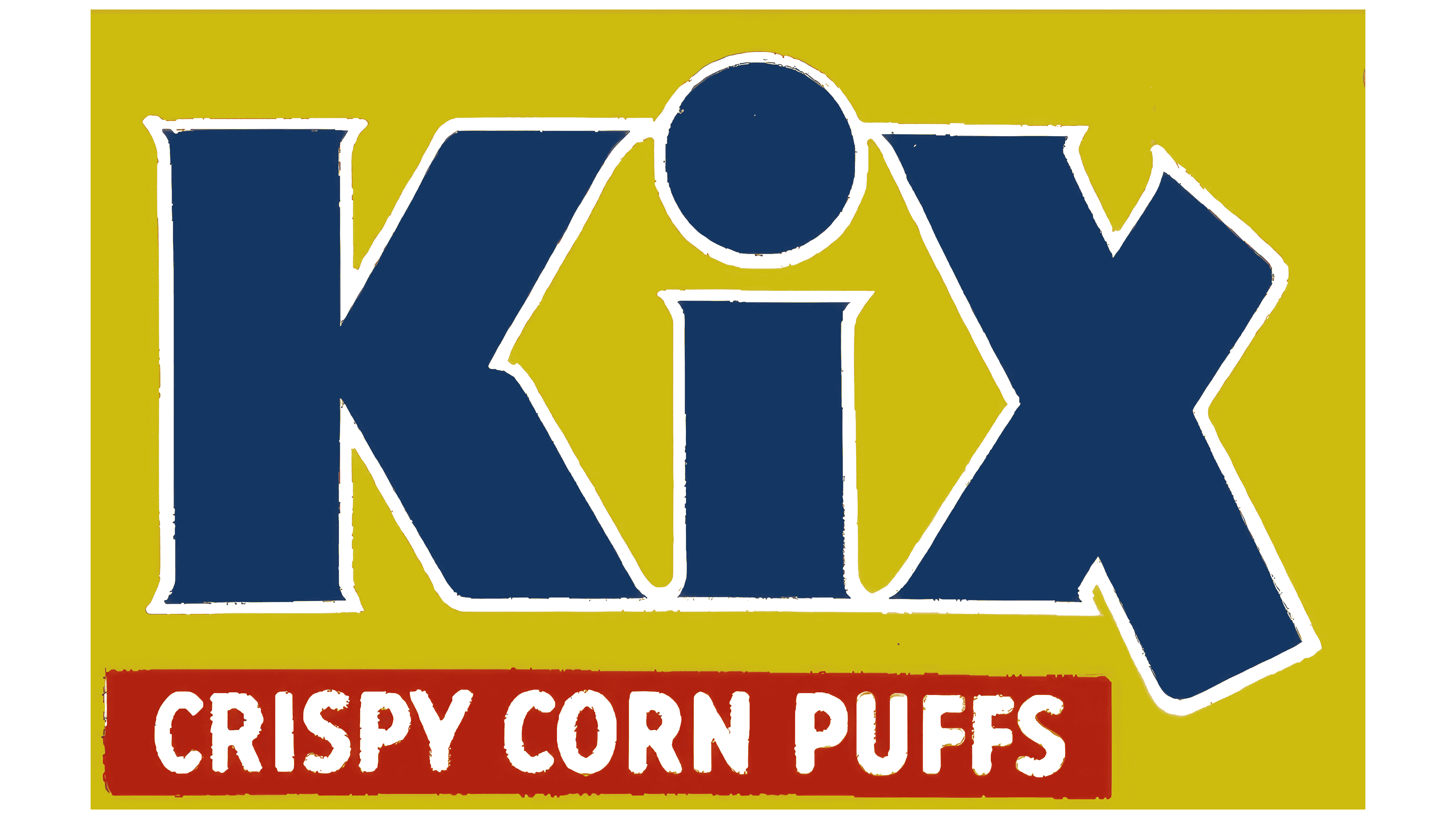
At the center of the composition was the large word “Kix.” The massive letters were built on geometric forms, devoid of serifs, tightly arranged. A white outline reinforced the separation from the yellow background, creating clear boundaries. The word appeared solid, and the letter spacing emphasized the compact construction.
The yellow background was preserved as a constant foundation, but now it served as a stable field for the name. Bright bursts and decorative inserts, characteristic of the earlier stage, disappeared: the viewer focused exclusively on the word “Kix.”
At the bottom appeared a red rectangular banner with the phrase “CRISPY CORN PUFFS.” White uppercase letters on the red field created a confident accent, shifting the balance toward informativeness.
The color system consisted of four shades: yellow, blue, white, and red. Their relationship formed a solid foundation for the further development of the brand’s visual language. The contrast of yellow and blue sets the main tone, while white acts as a separator, and red introduces an energetic signal.
1953 – 1961
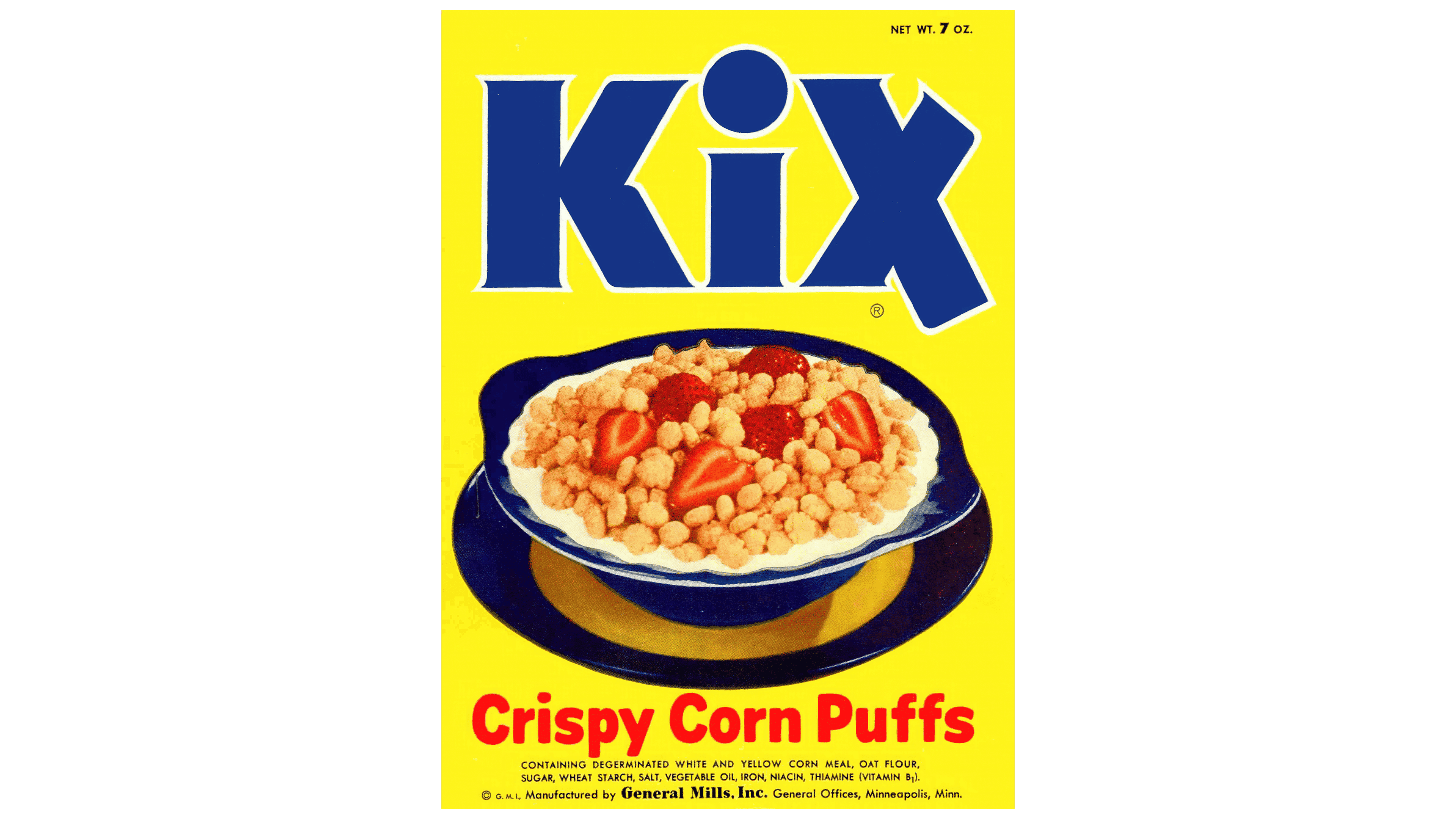
In the mid-20th century, the visual concept of Kix became more orderly and restrained, in line with the general trends of packaging design of the time. Advertising expressiveness gave way to clarity of presentation and reliable brand identification. The primary objective was to maintain continuity with earlier versions while adapting the image to meet the evolving market expectations.
The composition was built around the large word “Kix.” The typeface was massive, in a deep blue shade. The letterforms were geometrically precise, characterized by wide strokes, angular joins, and emphasized verticals. The layout was compact. The contours of the letters were softer than in earlier versions. The name looked less aggressive and fit better into the overall visual system.
The yellow background was preserved as a constant feature. It set an energetic tone and provided contrast with the deep blue of the lettering. The combination created a visual hierarchy in which the name was perceived first, followed by supporting information.
At the bottom of the composition was the slogan “Crispy Corn Puffs.” Red lettering on the yellow background stood out as an accent block, helping complete the structure. This element served as an explanatory note, reinforcing the link between the brand and the product.
The palette was limited to four key colors: yellow, blue, red, and white. Their combination kept the design from being overloaded and created a clear perceptual rhythm. The energetic background, dominant blue lettering, and red descriptor formed the system on which the brand’s subsequent identity was built.
1961 – 1973

One of the new details that stood out in the updated Kix logo was the dot above the letter “i,” transformed into a decorative symbol resembling a snowflake or star. It was no longer a utilitarian accent but became an independent mark that gave the image individuality. Against this background, the entire logo acquired a more decorative and playful character, in line with the move toward a refreshed visual presentation.
The word “Kix” retained its massive outlines, but each letter was given white diagonal and vertical lines. These created the effect of highlights, visualizing a shine and adding dynamism. This enlivened the form, making it more expressive.
The yellow-orange background connected the design to the corn-based product, while the contrast with the deep blue lettering enhanced readability. At the top appeared the word “CORN,” set in a strict upright typeface. It emphasized the natural ingredient and worked as an additional informational block.
At the bottom was the slogan “Goodness in crispy corn puffs.” The text was set in small letters and added an advertising subtext. Its presence completed the composition, forming a consistent hierarchy: from the brand to the ingredient and then to the product promise.
1973 – 1980
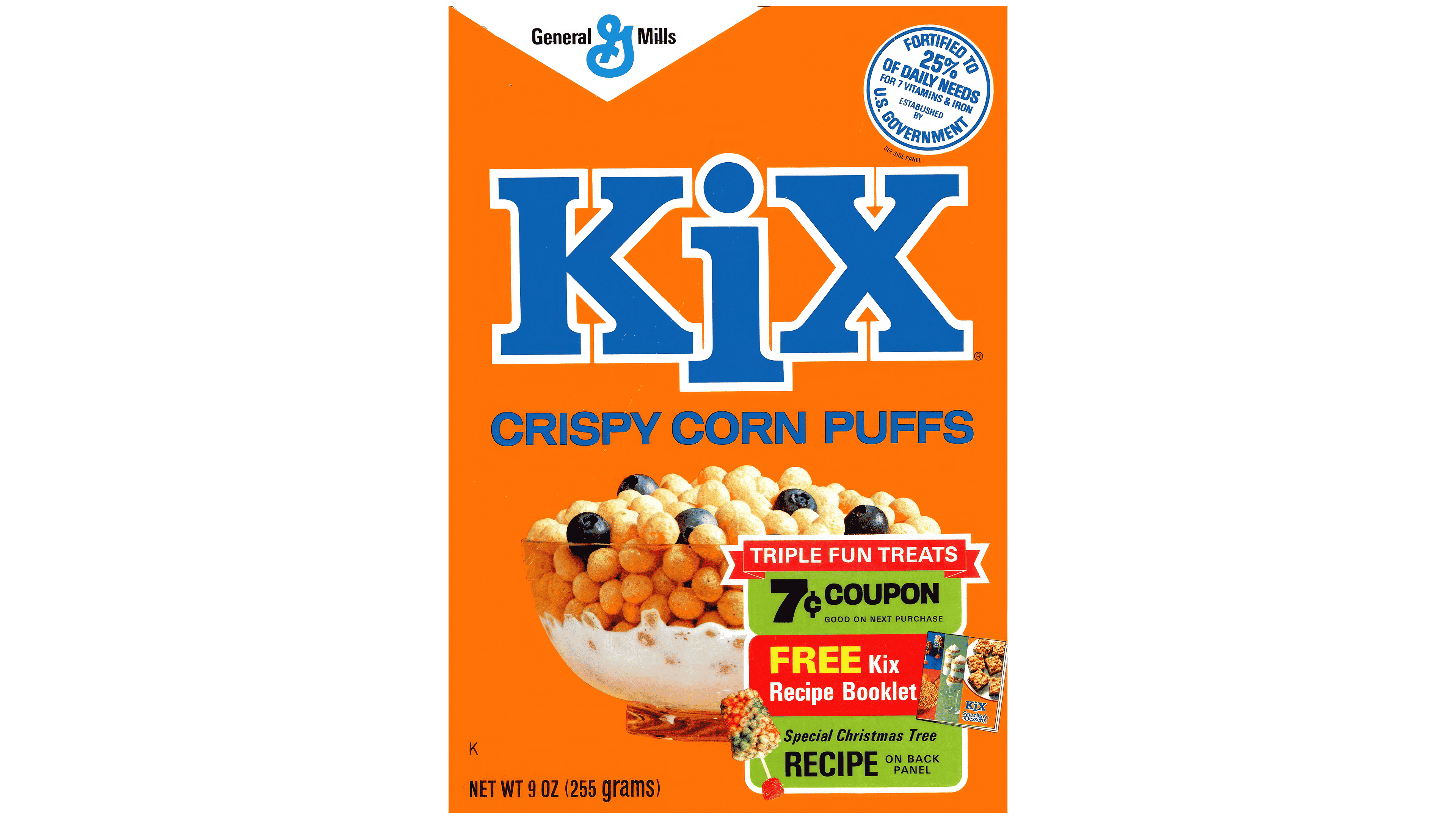
The update associated with the 1970s focused on the decade’s energy and a desire to emphasize modernity. The visual concept of Kix acquired new features, preserving continuity while increasing its appeal to the mass consumer.
The composition was built around the brand name. Large blue letters were given a white outline, which strengthened contrast and added volume. This made the wordmark bright and distinct against the background field. Compared to earlier versions, the geometry remained unchanged, but the lines became softer and the connections smoother, resulting in a lighter visual image.
The background shifted from the familiar yellow to an orange palette. The change emphasized novelty and moved the composition beyond established conventions. The contrast between orange and blue created a tension that drew attention to the logo.
Beneath the name was the informational block “CRISPY CORN PUFFS.” It was set in uppercase blue, maintaining a color connection with the main word. The typeface was strict and upright, serving a functional role in product labeling rather than a decorative one.
1980 – 1994
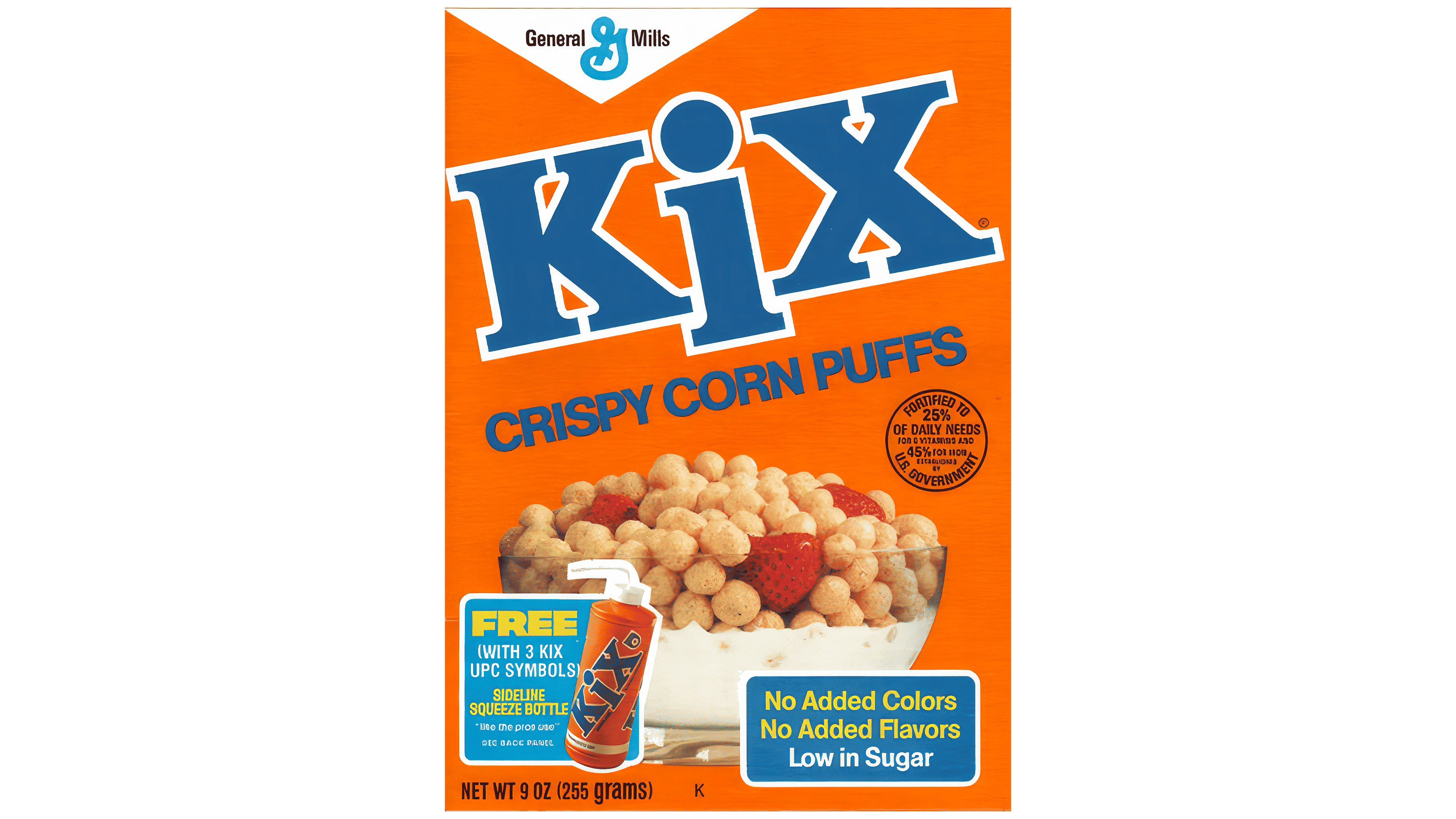
Unlike the previous version with a horizontal composition, the new design placed the word “Kix” diagonally. This gave the logo dynamism and a sense of movement that reflected the era’s modern spirit.
The main wordmark was executed in large blue lettering with thick strokes and smooth curves. The letter geometry became softer, and the image looked friendly yet still confident. A white outline reinforced the contrast with the background and gave the letters volume.
The background was a bright orange shade, continuing the 1970s trend but appearing more intense in this version. The diagonal arrangement heightened the sense of energy and emphasized the brand’s renewed character.
Below the main wordmark was the slogan “CRISPY CORN PUFFS.” The text was set in the same blue as the name, maintaining the visual concept’s unity.
1994 – 2002
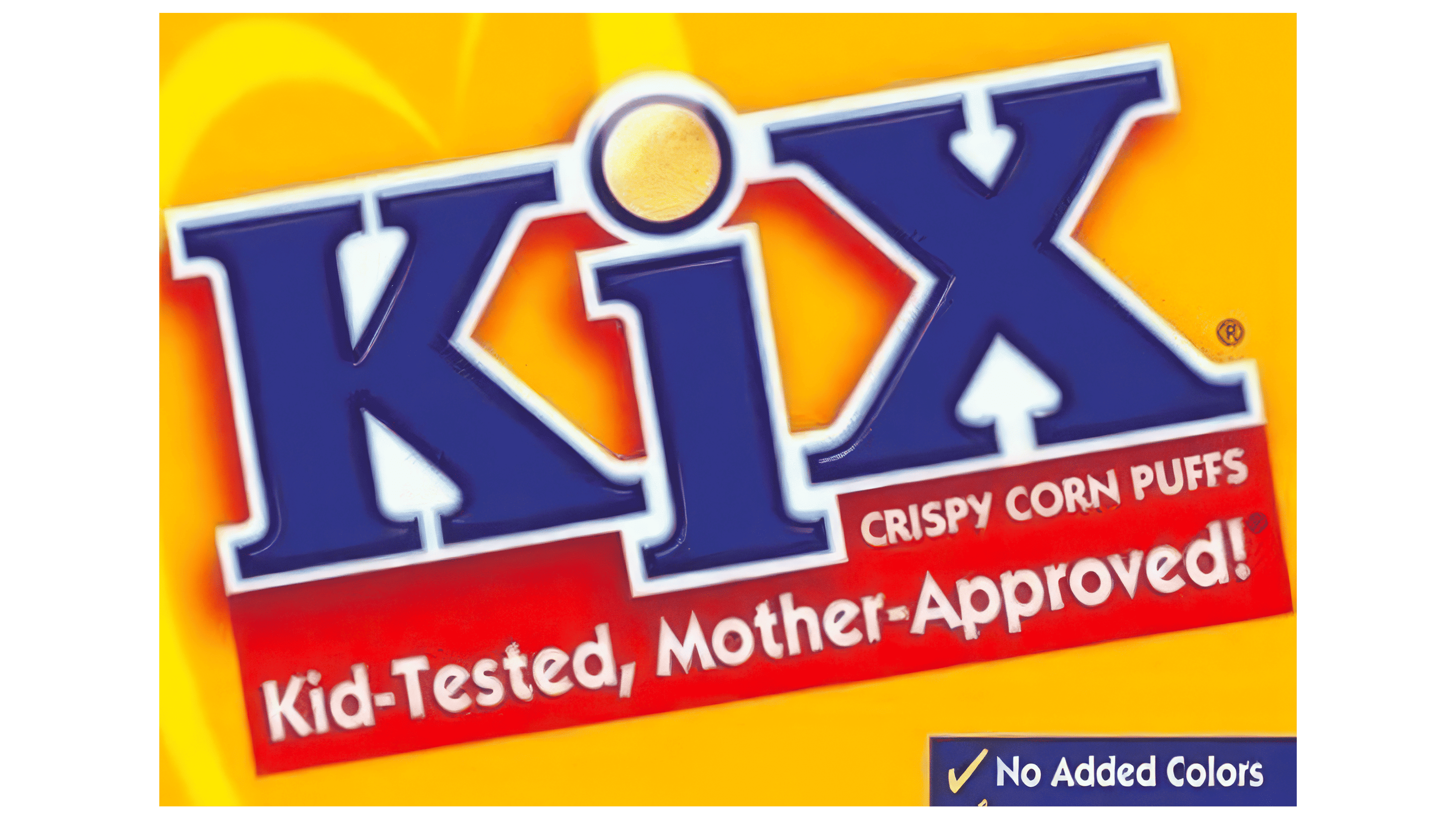
In the mid-1990s, the brand’s visual language was reinterpreted in the spirit of the decade, when food packaging emphasized volume, saturation, and energy. The new look of Kix was built on the same basic elements but reworked to align with the aesthetics of the time and appear more expressive to the mass buyer.
The composition centered on the large blue wordmark “Kix”. To add depth, a white outline and a soft shadow were introduced, creating the illusion of three-dimensionality. This made the letters feel substantial but not static, as light effects added movement and liveliness. The dot over the “i” was replaced with a golden circle, symbolizing airy corn puffs, which directly associates with the product and reinforces recognition.
The background was a smooth, yellow light gradient. This filled the surface with warmth and added a sense of motion. At the bottom was a red diagonal block containing the slogan “Kid-Tested, Mother-Approved!” and the phrase “Crispy Corn Puffs” in white lettering. The contrast of red and white created an energetic impression, while the diagonal line reinforced the sense of direction and activity.
Structurally, the mark combined the massive wordmark with additional compositional accents, making the image cohesive and visually appealing. The typeface was sans serif with enlarged rounded glyphs, making it easy to read for both children and adults. The use of shadow and outline worked as optical adjustments, softening the mass of the letters.
The palette was built around three dominant colors: blue for the letters, yellow for the background, and red for the lower block. White was used for outlines and text. The distribution of shades supported a hierarchy in which attention was focused on the name, while the additional elements reinforced the energetic presentation.
2002 – 2009
One of the changes in the early 2000s was the redesign of the Kix brand mark, which shifted toward a softer and friendlier image. The brand sought to emphasize its family-oriented approach, and the visual language began to build trust and a positive mood among the audience.
The composition was based on the wordmark placed at a slant. This added a sense of activity and evoked associations with fun and children’s energy. The letters used an updated typeface with rounded outlines. The lines transitioned smoothly, with strokes that were thick at the base and tapered toward the top. The letters appeared reliable yet light, adding a playful element.
The palette was built on a vertical gradient connecting deep blue and light blue. The smooth transition of shades gave depth and freshness, enhancing the perception of volume. The letters were outlined with a double contour in white and dark, with an added light reflection. The contour separated the wordmark from the background, creating the effect of an illuminated surface.
The mark received another important accent: the dot above the “i” was transformed into a golden sphere. Its shape and color evoked the image of a corn product. A highlight on the surface gave it a natural appearance and evoked associations with an appetizing texture.
2009 – 2018
At the beginning of a new stage in Kix’s visual identity, designers focused on creating a lighter, friendlier image. Compared to the previous version, the massiveness has disappeared: angular forms have been replaced with rounded ones, reminiscent of the style of children’s illustrations. The typeface also changed: the letters became wider, the lines smoother, and the overall design gained a softness that was comfortable for both children and their parents.
The composition retained recognizable brand markers but was executed in a distinctly different way. The dot above the “i” once again served as a visual reference to corn puffs. Designers used a stylized mark with a soft highlight. Unlike the 2002 version, which featured a realistic sphere, this time it was closer to a playful, cartoon aesthetic.
The typeface was based on rounded proportions without serifs. The letter shapes lacked sharp angles, and the stroke distribution was designed so that the lower part appeared stable and the upper part light and open. The letter spacing was balanced, and the wordmark appeared cohesive and fluid.
The palette retained the familiar blue range but presented it in a more complex way: from a deep shade at the base of the letters to light blue at the top. The gradient created a sense of volume and freshness without overloading the form. Removing the heavy outline made the Kix emblem appear visually “airy,” reinforcing its associative link with the crunchy product.
The design composition was built around the idea of positivity and cheerfulness. The blue color ensured continuity and recognition, the golden sphere connected the mark to the product, and the soft shapes and smooth transitions created a sense of modernity. The symbolism was aimed at the family format and a child audience, where lightness and friendliness were perceived as the main qualities of the new image.
2018 – today
The key emphasis of Kix’s brand style in recent years has been on a sense of naturalness and trust. Complex effects have been replaced by a cleaner presentation, in which the large wordmark is constructed from simple, rounded forms. The letters are precisely proportioned, free of aggressive details, and perceived as soft. The composition is arranged along a light curve, creating dynamism and highlighting the letter “i” as the visual focal point.
Dense outlines and even stroke thickness characterize the typography. The rounded forms make the name approachable, while the geometric balance lends it confidence. The wordmark is sans serif, its character rooted in a modern interpretation.
The palette is built on the contrast of deep blue and white. The letters are rendered in blue, with their outlines highlighted in white, which improves readability and separates them from the bright orange background.
A realistic image of a corn puff replaced the dot above the “i.” This connection directly links the logo to the product, creating a sense of authenticity and appealing to the theme of naturalness. The realistic element contrasts with the simplified letterforms, enhancing the accent.
At the bottom is the slogan “KID-TESTED. PARENT-APPROVED.” Its placement along a curve supports the overall composition and completes the visual concept. The slogan reinforces the brand’s family positioning and adds emotional depth.