 Rockwell Automation Logo PNG
Modern manufacturing relies on automated systems that control equipment, monitor parameters, and integrate individual sections into a single process. Conveyors, sensors, and software systems operate in sync, ensuring product output under specified conditions. The Rockwell Automation logo is associated with a company that develops industrial automation technologies, including control systems, software, and equipment for enterprises.
Rockwell Automation traces its history to 1903. That year, engineers Lynde Bradley and Stanton Allen founded the Allen Bradley Company in Milwaukee. The first product was a rheostat for controlling the speed of electric motors. It was used in industrial equipment. In 1969, Allen-Bradley introduced the first programmable logic controller, PLC.
In 1985, the company was acquired by Rockwell International. This conglomerate operated in the aerospace and defense industries. In 2001, Rockwell International was split into two companies. After the separation, Rockwell Automation became an independent manufacturer of control systems and industrial software.
In the 2000s, the company developed digital technologies and acquired new businesses, including ICS Triplex and Maverick Technologies. In 2010, the PlantPAx platform was launched. In 2018, the FactoryTalk suite was introduced for production data analysis.
After 2020, investment in automation strengthened the company’s position. In 2022, Rockwell Automation acquired Plex Systems for $ 2.2 billion. In 2023, it began applying artificial intelligence for predictive equipment maintenance.
The company remains one of the world’s leaders in industrial automation. It provides control systems, drives, robots, and digital solutions for enterprises in more than 100 countries.
Meaning and History
What is Rockwell Automation?
An American company developing industrial automation and production control systems. It includes the Allen-Bradley, Rockwell Software, and Dodge brands. Its business is divided into three segments: Intelligent Devices, Software & Control, and Lifecycle Services. The core is the integrated architecture that connects the Logix and FactoryTalk platforms to the hardware in a unified digital system. The product range includes ControlLogix and CompactLogix controllers, PowerFlex drives, PanelView panels, and GuardLogix solutions. The company works with enterprises across various industries and employs more than 22,000 people in 80 countries.
before 2018

Rockwell Automation grew from the Allen-Bradley line, so the brand’s early visual history began long before its current name appeared. Dr. Stanton Allen and Lynde Bradley founded the Compression Rheostat Company in 1903. In 1909, the business adopted the name Allen-Bradley Company, formed from the founders’ last names.
The Allen-Bradley octagon appeared in 1923 and became one of the company’s main early symbols. Rockwell International acquired Allen-Bradley for $1.651 billion in 1985. Allen-Bradley remained within the group as a product brand. The Rockwell Automation name appeared in 2001 following the separation of Rockwell Collins and the company’s shift toward industrial automation.
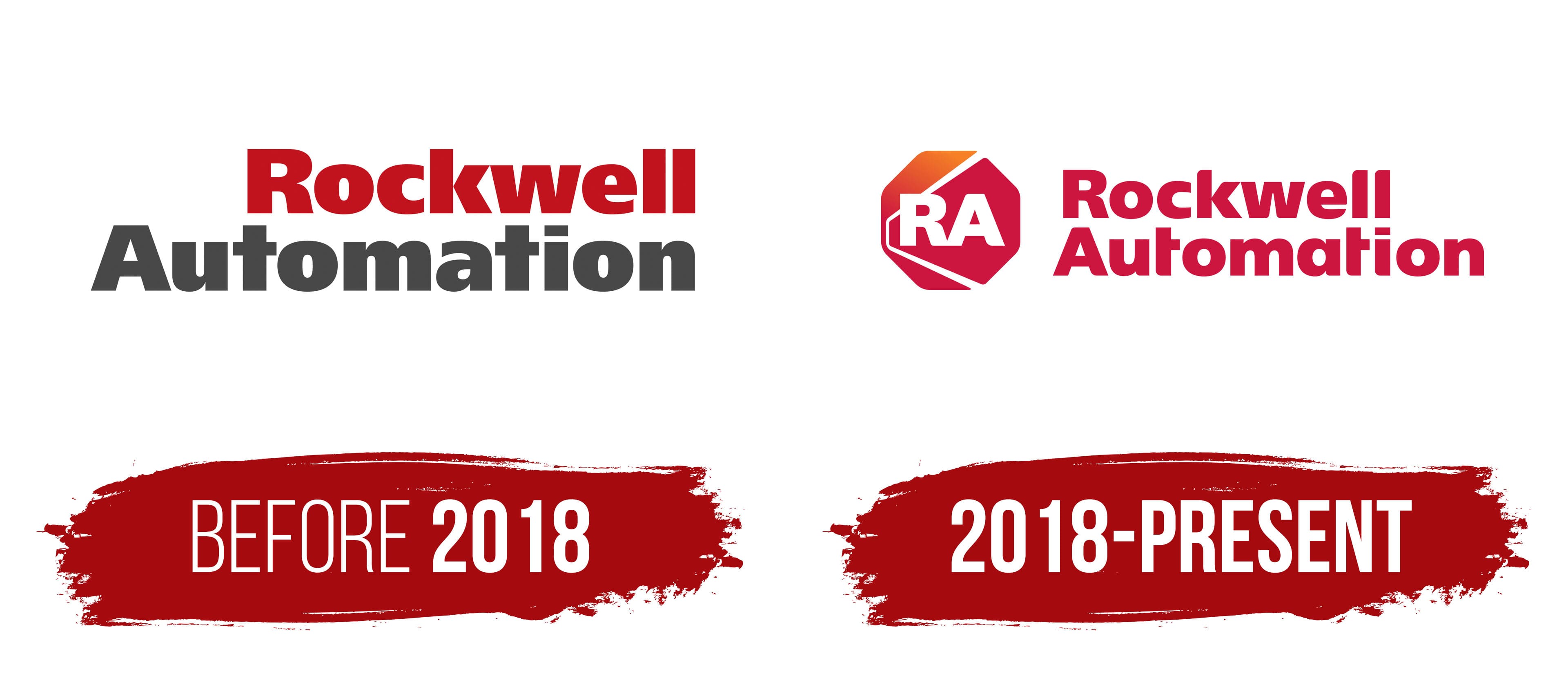
Before 2019, the Rockwell Automation corporate logo consisted entirely of text. Two lines containing the company name performed the visual role. Rockwell appeared on the upper line and Automation on the lower line. Both words were aligned to the right, giving the wordmark the appearance of a compact business block.
Rockwell appeared in a saturated red, while Automation was gray. Both parts used a bold upright sans-serif typeface resembling modified versions of Helvetica or Arial Black. Large letters and heavy strokes reflected the company’s industrial profile. The Rockwell name represented the corporate line, while Automation identified its field of operation.
2018 – today
In 2019, Rockwell Automation updated its logo and introduced a new brand promise. The project was developed with the international branding agency Siegel+Gale. The identity received a red-orange octagon containing the “RA” monogram, restoring a connection with the Allen-Bradley heritage.
The octagon entered the brand’s history through Allen-Bradley. The company had used an eight-sided form as a trademark symbol since 1923. After Rockwell International acquired Allen-Bradley in 1985, the brand’s heritage remained within the product line. In the 2019 version, the octagon moved to the forefront of Rockwell Automation’s corporate identity.
The update coincided with the company’s new positioning. Rockwell Automation began communicating about industrial digital transformation and the Connected Enterprise. The logo places the “RA” monogram beside the Rockwell Automation name without the former separation between the corporate wordmark and product lines.
An octagon resembling an isometric form appears on the left. White “RA” letters are placed inside. An angular white line runs through the figure, dividing it into separate sections. In the upper left corner, the color transitions from magenta to warm orange. The rest of the symbol uses a magenta-red shade.
The Rockwell Automation name appears on the right in two lines. Rockwell stands above Automation. Both words use the same size and weight. The color is magenta-red. The sans-serif typeface resembles Neo Sans or a modified version of Helvetica Rounded Bold. Together with the octagon, the text has a softer appearance than the previous heavy version while retaining the brand’s industrial scale.