 Veeam Logo PNG
The Veeam logo combines creativity and individuality, representing the company and conveying an atmosphere of high professionalism. The emblem reflects the essence of IT technologies that simplify user interaction with data synchronization and management programs.
Veeam was founded in Baar, Switzerland, in 2006 by Ratmir Timashev and Andrei Baronov, who had previously created Aelita Software and sold it to Quest Software. The company began with tools for virtual machine management, mainly for VMware environments. Its first product, Monitor, came out in 2007 and gave administrators a way to track virtual machine performance.
In 2008, Veeam released Backup & Replication, the product that became the core of its business. It was built for backup and recovery in virtual environments and helped define the company’s early market position. In 2009, Veeam entered the Hyper-V segment, and in 2010 it launched ONE for monitoring, reporting, and capacity planning. By 2011, the company had 25,000 customers worldwide.
In 2012, Veeam promoted the idea of modern data protection. Backup & Replication v7 followed in 2013 with stronger support for hybrid and cloud environments. In 2014, Availability Suite joined Backup & Replication with ONE for enterprise clients. By 2015, the company had passed 150,000 customers and reached $1 billion in cumulative revenue. In 2016, it expanded into physical-server backup for Linux and Windows Server.
Availability Suite v10 arrived in 2017 with cloud protection, including Microsoft Azure and Amazon Web Services support. Annual revenue passed $1 billion in 2018. Insight Partners acquired Veeam for $5 billion in January 2020, while the company continued to operate independently. Version 11 followed in 2021 with ransomware protection, cloud support, and container backup. In 2022, Backup for 365 v6 expanded protection across the Microsoft ecosystem, including Teams, SharePoint Online, and OneDrive for Business. In 2023 and 2024, Veeam added AI tools, machine-learning features, and wider cloud and hardware partnerships.
Meaning and History
What is Veeam?
It provides backup, disaster recovery, and intelligent data management software for virtual, physical, and multi-cloud infrastructures. The company’s products help organizations ensure data availability and protection across on-premises, cloud, and hybrid environments. It is known for its Veeam Availability Suite, which offers comprehensive backup and recovery solutions, as well as monitoring and analytics tools. The company provides high recovery speed, data loss prevention, proven recoverability, data utilization, and full visibility to help enterprises maintain continuous operations and meet data protection requirements.
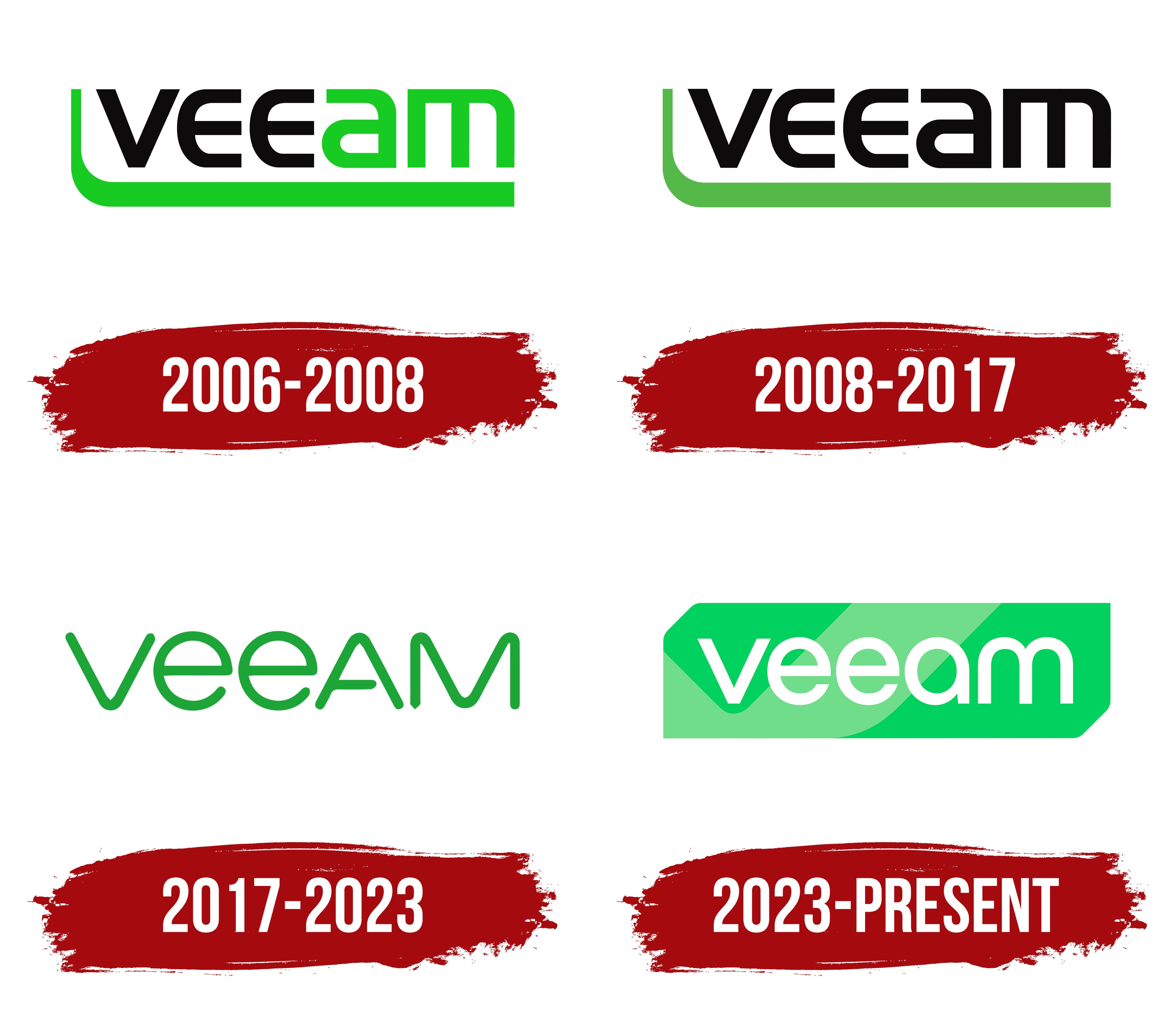
2006 – 2008
To creatively represent a serious industry in a clear, visually appealing way, Veeam has combined sharp color contrast and smooth graphics in its emblem. With its striking color scheme, clear structure, and simple form, the logo makes it obvious that this is an exceptional player in the IT field.
The color contrast between black and bright green effectively captures attention. These colors work well together, balancing each other and setting a tone for a progressive perception of the brand, as its products are virtual rather than physical. This approach is intended to convey the modernity and innovation of the company’s digital developments.
- The first half of the name, “vee,” is in black, representing the letter “V” and standing for “Virtual.”
- The second part, “am,” is in green, representing the letter “M” from the word “Machine.”
Thus, the Veeam logo is based on an abbreviation presented in a phonetic form, reflecting how the letters in the acronym are pronounced. This significantly influenced the brand’s identity, creating a new word. The visual style is primarily text-based, minimalist, modern, and vivid, thanks to the optimal color palette and its harmonious combination with the font.
Several features of the typeface are worth noting. First, all letters are lowercase, though they are large. They feature 90-degree angles that blend harmoniously with smooth curves. Second, the letters “e” and “a” are remarkably similar. The designers noticed this and aimed to emphasize it in the logo. Upon closer inspection, you can see that they almost appear as mirror reflections of each other, with only the side curve preventing full symmetry.
Beneath the name is a bold stripe that adds dynamism to the emblem, as it appears to be in motion. The curve enhances this effect: a short vertical stroke flows smoothly into a long horizontal line. A similar curve exists in the top right corner (at the “m”). It balances the logo and gives it a sense of cohesion.
2008 – 2017
Minor changes to the Veeam logo have significantly impacted its recognition among clients. This is primarily because they reflect the IT company’s refined concept, which sought to showcase its seriousness, professionalism, and importance in the virtual world. At the same time, the company aimed to maintain its familiar “face” so that users could easily identify its products among competitors. The task was accomplished simply and effectively by changing the color.
As a result, the emblem became less playful and less bright than before. Two important steps were taken to achieve this:
- The bright green color was shifted to a calmer spectrum; it became darker, deeper, more restrained, and businesslike.
- The name was recolored in black, symbolizing seriousness, sophistication, elegance, and strength.
Despite the minimal adjustment, the logo radiates a different tone, conveying novelty and practicality. The sharp edges of the letters with clean angles remain a highlight of the visual identity. The curves also remain untouched: the upper one on the right (on the “m”) and the lower one on the left (at the transition from the vertical stripe to the horizontal). They maintain visual balance so the glyphs don’t seem too rigid or dry, as the smooth contours convey a calm atmosphere.
The lowercase font represents the accessibility of the company’s services to all users: it is compact, informal, and simple. At the same time, the letters appear innovative, with a non-classical shape that combines assertiveness and softness, reliability and delicacy, and utility and aesthetics. The smooth edges, rounded curves, and the straight line at the bottom emphasize the developers’ precision and attention to detail in creating software.
2017 – 2023
This is a very intriguing version of the Veeam logo that combines uppercase and lowercase letters in a single word: both “e”s are lowercase, while “V,” “A,” and “M” are uppercase. Despite the difference in case, all the glyphs are the same size; they don’t vary in height. The smooth strokes convey confidence and reliability, showcasing the company’s high capabilities in digital technologies.
The largest letter is “M.” It takes up 1.5 times as much space as the others. Its curved tops smoothly transition into the lower strokes, giving the impression that it forms a single line bent to fit the desired shape. Interestingly, the left leg of the glyph ends with a point, while the right one ends with a rounded edge, adding another unique aspect to the emblem.
The neighboring “A” is missing a small segment of its crossbar, making the stroke open-ended and suggesting the freedom of action for clients using Veeam’s original software. Both ends of this symbol are rounded, and the top is curved, giving the impression that the right leg flows seamlessly into the left, creating a sense of continuous cyclicity and unity. The capital “V” is designed in a similar style. But the most rounded of all are the two “e” s. They are ring-shaped, bold, and smooth.
The mix of uppercase and lowercase glyphs, soft contours, and rounded elements gives the logo a playful feel, which doesn’t entirely match the company’s specialization. This dissonance is striking, as it isn’t justified by the brand’s concept, which centers on precision and forward-thinking, qualities not fully reflected here. However, other elements hint at active growth.
For instance, green balances the situation, symbolizing continuous growth, youth, the pursuit of fresh ideas, and the drive toward new heights. Combined with the modern, rounded font, it evokes a sense of natural balance, harmony, perpetual motion, and progress. Paired with a white background, the green adds additional softness. It encourages a positive perception, showing the company’s reliability and confirming its high level of professionalism. Thin, smooth lines give the emblem a sense of lightness and elegance.
2023 – today
This version of the Veeam logo is characterized by creativity. It is visible in every detail, even in the standard grotesque font used for the inscription. The visual identity design has radically changed, elevating the brand to a higher level of style and presentation.
The most significant change occurred in the background: it appeared for the first time, having previously been absent as a full-fledged element. Now, the name is placed within a horizontal rectangle with two cut-off corners. These corners echo earlier versions of the emblem, which had rounded edges at the top right and bottom left. Now, the corners are reversed, top-left and bottom-right. This format added unity and purpose to the sign, as the cuts look harmonious and support the logo’s internal dynamism.
The wide whitish stripe creates a similar effect, curved into a boomerang shape. It is located on the left side of the rectangle, taking up a lot of space. In the background, the second “e” is fully visible, while the first “e” and “a” are partially visible. However, the smoothly curved line is not just a ribbon but a fragment of the letter “v,” which stands at the beginning of the name. The remaining geometric figure is colored in a pastel green, light, and slightly powdered. It fills the space with powerful energy, hinting at youthful enthusiasm, growth, and hard work.
The precise, straight edges of the rectangle contrast with the rounded font, which features smooth glyph outlines. The inscription is made in bold letters with soft contours, except for the “v,” which has no rounded strokes, only straight lines. This is done to highlight it and draw attention, as it represents the abbreviation “Virtual,” the IT company’s main specialization.
The other characters are smooth, sleek, and rounded. They are unified by the absence of serifs and the use of lowercase, as the emblem continues to be built on lowercase glyphs, demonstrating the accessibility of the company’s products to most users. The white name on a light green background evokes joy, cheerfulness, and good spirits.