


 ASML Logo PNG
The ASML logo reflects the company’s essence as a leader in high technology. It is the only company worldwide to develop systems for EUV lithography. The minimalist and sleek design emphasizes the high precision essential for patterning silicon wafers in the production of modern microchips.
ASML was founded in 1984 in Veldhoven, the Netherlands, as a joint venture between Advanced Semiconductor Materials International and Philips. The company was founded to develop lithography systems for semiconductor manufacturing, the process of producing integrated circuits. Its name came from Advanced Semiconductor Materials Lithography.
In its early years, ASML produced PAS 2000 steppers using technology licensed from Perkin-Elmer. In 1986, PAS 2500 became its first in-house product. The company opened its first foreign office in the United States in 1988, giving it closer access to Silicon Valley clients. In 1991, PAS 5000 became its first system for 200 mm wafers.
A major corporate change came in 1995, when ASML became independent after the sale of the partner stake and held an IPO on NASDAQ and the Amsterdam exchange. In 1997, PAS 5500 introduced step-and-scan technology. In 2000, the company acquired the lithography systems division of Silicon Valley Group, expanding its position in the United States.
ASML began EUV work in 2001. TWINSCAN XT:1900i followed in 2007, and an EUV prototype appeared in 2010. In 2012, Intel, TSMC, and Samsung invested 5.3 billion euros to support the development of advanced lithography. ASML bought Hermes Microvision Inc. in 2016, began commercial sales of TWINSCAN NXE:3400B in 2018, shipped 26 EUV systems in 2019, introduced NXE:3400C in 2020, reached 100 EUV shipments in 2022, and completed High-NA EUV prototype testing in 2023.
Meaning and History
What is ASML?
It is a leading Dutch company that supplies advanced semiconductor manufacturing equipment. The company specializes in designing and manufacturing photolithography machines for fabricating integrated circuits (ICs) known as microchips. The brand’s advanced technology enables the production of smaller, faster, and more energy-efficient microchips, playing a crucial role in developing the electronics industry. Major semiconductor manufacturers worldwide use the company’s products, including Intel, Samsung, and TSMC.
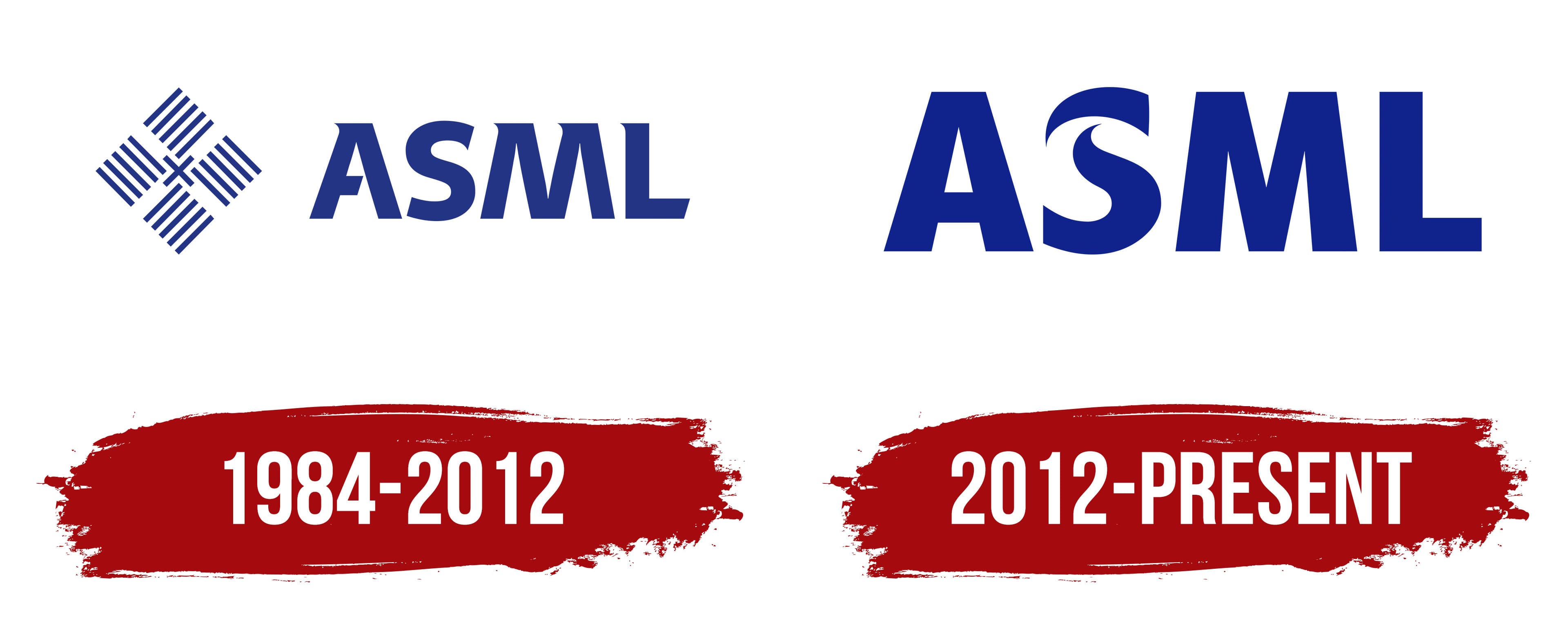
1984 – 2012
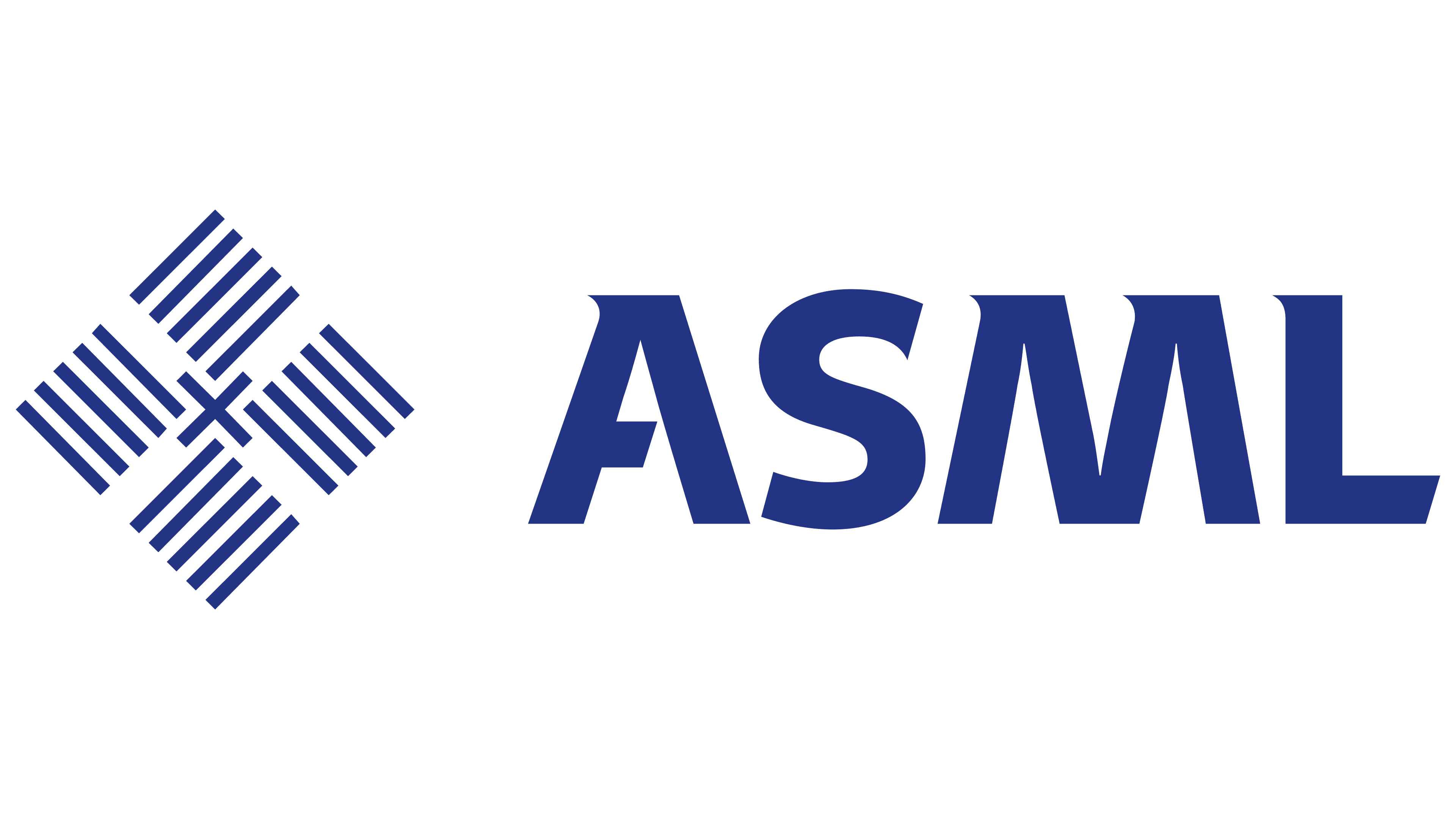
The ASML logo is designed in a minimalist style to emphasize the company’s modernity and innovation. It consists of two parts: an abstract pattern and a brief inscription, which, until 1988, was an abbreviation for Advanced Semiconductor Materials Lithography before becoming the official brand name.
The graphic symbol resembles a diamond composed of four short-line blocks. They are separated by white negative space shaped like a cross, with a small letter “X” in the center. This “X” has no particular meaning; it is simply two crossed lines.
The large diamond is a stylized representation of a microchip, aligning with ASML’s primary mission of producing photolithography machines used in chip manufacturing. Their technology enables printing tiny patterns on silicon wafers with precise control over shape and size. The emblem mimics the intricate design of an integrated circuit, perfectly reflecting the company’s field of activity.
Next to the striped diamond is the word “ASML,” written in a custom font with short, sharp serifs. Each letter has its specific characteristic:
- The “A” lacks a fragment of the horizontal bar, creating a sense of openness.
- The upper end of the “S” is slightly pointed to match the serifs on the other glyphs.
- The “M” has a relatively wide middle, maintaining a balance between the lines.
- The bottom edge of the “L” is cut diagonally at the same angle as the bar of the “A.”
All serifs are at the top and point only to the left, giving the impression that the inscription is rushing forward at high speed. This illusion of movement indicates the company’s drive to develop new technologies in the semiconductor industry. These nuances make the logo expressive and highlight the innovativeness of the photolithography machine manufacturer. The letters’ consistent stroke thickness and precisely calculated proportions convey a sense of stability and reliability.
The font’s geometric style pairs well with the dark blue color used for both the brand name and the abstract pattern. This color is often associated with high technology, which signifies professionalism, reliability, and stability.
2012 – today
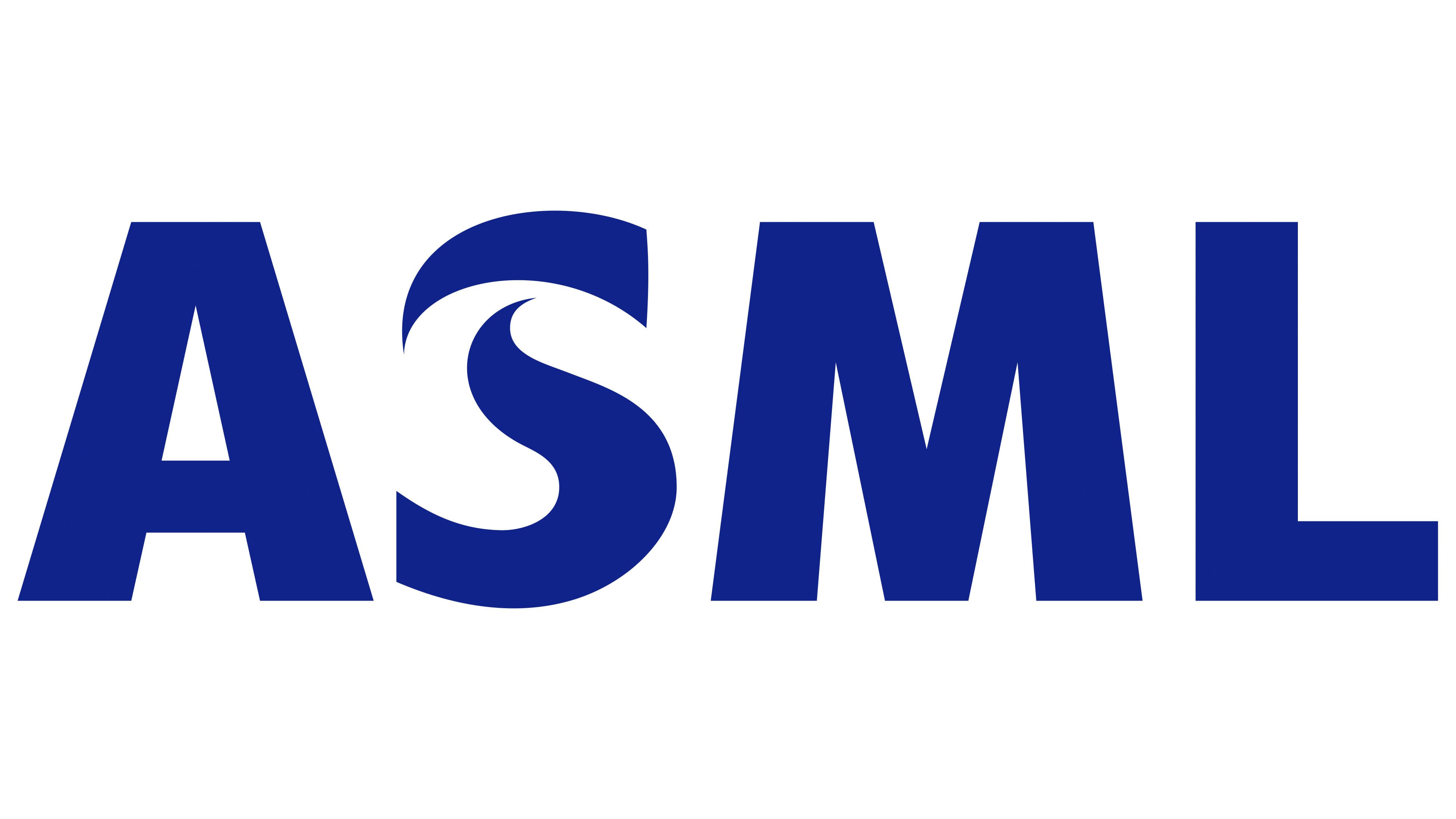
In 2012, ASML Corporation simplified its logo to align with a minimalist style. As a result, the complex pattern of stripes was removed, leaving only the short, four-letter inscription. Designers combined the wordmark with a new graphic symbol, two wavy lines forming a semblance of an “S.”
The curved shape of the “S” resembles a flow, symbolizing the photolithography process. In this context, the uneven lines represent light waves used in ASML equipment to print images on silicon wafers. The visual movement also conveys continuous development and progress, reflecting the company’s drive for innovation in semiconductor technology.
The rest of the inscription is straightforward, with “A,” “M,” and “L” rendered in a standard bold grotesque font. These letters balance the fluidity of the “S,” making the logo noticeable through contrasting forms. The uniform stroke thickness and the absence of serifs and other decorative elements reflect the high precision essential in photolithography machines.
The uppercase font with clear, straight lines conveys the seriousness and professionalism of ASML. The inscription’s geometric style pairs well with the dark blue color, enhancing the sense of reliability and technological prowess. The chosen palette underscores the company’s innovative nature and achievements in producing advanced equipment.