 Tapestry Logo PNG
Fashion brands can sit under a single corporate structure, with management at the strategy and development levels, while the brands retain their individuality. This system enables the simultaneous development of multiple lines and engagement with different market segments. The Tapestry logo represents the company that manages the Coach, Kate Spade, and Stuart Weitzman brands, coordinating their activities and development.
In 1941, six craftsmen opened a small Manhattan workshop called Gail Leather Products. There, they hand-made wallets and accessories from genuine leather. In 1946, Miles and Lillian Cahn, owners of Manhattan Leather Bags, joined the business. They soon took charge of production. Miles developed a new leather treatment technique. Lillian suggested producing women’s handbags.
In 1961, the Cahns bought the company and renamed it Coach. To refresh the style, they invited designer Bonnie Cashin. From 1962 to 1974, she shaped the brand’s signature look. Under her direction, products appeared in bright colors, with practical features and the recognizable toggle clasp.
In 1979, Lew Frankfort joined the company. In 1985, the Cahn family sold Coach to Sara Lee Corporation for $30 million. By the mid-1980s, boutiques had opened in Macy’s department stores and in New York. A large-scale retail network expansion began. In 2000, Sara Lee took Coach public on the New York Stock Exchange under the ticker COH.
In 2015, the company acquired the brand Stuart Weitzman for $574 million. In 2017, it purchased Kate Spade for $ 2.4 billion. On October 31, 2017, the holding company changed its name to Tapestry Inc. The new structure united three brands.
In 2023, Tapestry announced its intention to acquire Capri Holdings. However, the court blocked the $8.5 billion deal in 2024.
The company sold the Stuart Weitzman brand to Caleres Inc. and launched a $2.8 billion share repurchase program. It focused further development on the Coach and Kate Spade brands.
Meaning and History

What is Tapestry?
An American fashion holding company from New York that unites the brands Coach, Kate Spade New York, and Stuart Weitzman. Coach is the main revenue driver, represented by hundreds of boutiques worldwide. The company grew from a Manhattan leather workshop into a public holding company through a series of acquisitions. The network includes more than 1,400 stores, with most revenue coming from retail and online sales. Watches, eyewear, and fragrances are produced under licenses with Movado, Luxottica, Safilo, and Interparfums.
2015 – 2017

Before Tapestry was established, the Coach name applied to both the leather accessories brand and the company that owned it. The business began in 1941 as a small New York workshop where 6 artisans made wallets by hand. Miles and Lillian Cahn later took over. Handbags and accessories joined the product range, and Coach became the primary product brand.
Coach, Inc. was established in 2000, ahead of its listing on the New York Stock Exchange and separation from Sara Lee. The corporate logo retained a connection to the product brand. Large “COACH” lettering was accompanied by a thin “INC.” on the right. Both parts consisted of uppercase serif letters. Thick main strokes combined with thin connecting strokes in the name, while the abbreviation ending in a period identified the legal entity.
Following the acquisition of footwear company Stuart Weitzman in 2015, the identity came to represent 2 brands under one owner. The brand names appeared beneath the main “COACH INC.” line, retaining their separate typefaces. The upper line named the corporation, while the lower line showed its constituent brands.
A smaller “COACH,” repeating the main wordmark’s typeface, appeared at the lower left. “STUART WEITZMAN” sat on the right in narrow, very thin uppercase sans-serif letters. A thin vertical black line separated the names. Differences in letterform and stroke weight helped distinguish the two brands. The lettering and divider were black on a white background, continuing Coach’s color scheme.
2017
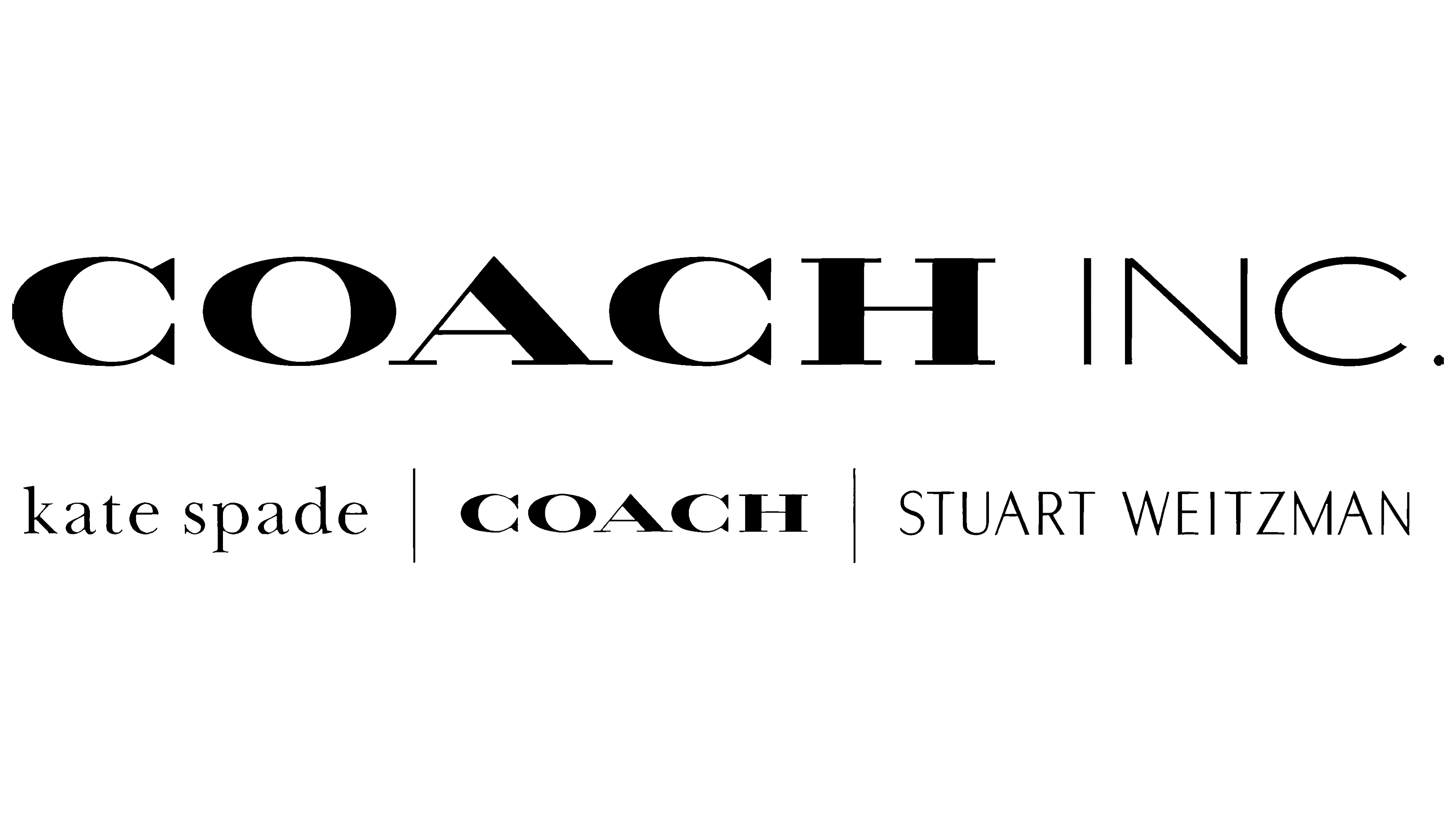
In the summer of 2017, Coach, Inc. completed its acquisition of Kate Spade & Company. The corporate logo was updated to add a third brand to the lower line. “kate spade” appeared on the left, “COACH” in the middle, and “STUART WEITZMAN” on the right. The upper Coach, Inc. wordmark was retained as the holding company’s name.
The “kate spade” name used thin lowercase serif letters. The other 2 brands retained their previous treatments. Thin vertical lines separated the 3 names. The lower row listed the group’s brands, using typography to convey their differences.
After the acquisitions of Stuart Weitzman and Kate Spade, the owner’s name still matched Coach, one of the brands in its portfolio. A mismatch emerged between the corporate name and the expanded group’s structure. The additional line showed the holding company’s composition, while Coach, Inc. remained the leading name in the logo.
2017 – today

The group of 3 fashion houses needed a shared name that gave Coach, Kate Spade, and Stuart Weitzman equal standing. On October 11, 2017, Coach, Inc. announced that it would become Tapestry, Inc. The legal name change took place on October 31, and the stock ticker COH was replaced with TPR. The changes applied to the parent company. The consumer brands continued operating under their existing names, retaining their identities and customer relationships.
New York-based Carbone Smolan Agency developed the name and corporate identity. The agency also prepared guidelines for the company’s written communications. The naming process took 2 to 3 months. From thousands of suggestions, the team compiled a list of several dozen options, then assessed their legal availability and cross-cultural reception in key markets.
Tapestry refers to fabric woven from multicolored threads. In the company’s interpretation, the threads represented people, cultures, and fashion brands brought together within a shared organization. The connection to craft conveyed skill, creativity, authenticity, and the participation of people from different backgrounds. The name’s broad meaning allowed new brands from different product categories and countries to join the group.
CEO Victor Luis explained the name as bringing differences together into a shared picture. During the naming process, the team considered the word’s everyday meaning and its associations with craft. Research showed that only a small proportion of younger participants knew of Carole King’s 1971 album Tapestry, so the musical connection remained secondary to their perception of the name.
The logo consisted of the single lowercase word “tapestry.” Bold black letters combined substantial serifs, soft joins, and moderate variation in stroke weight. The crossbar of the “t” was shortened, and the counter of the “e” was angled. The tail of the “y” descended below the baseline, curved upward, and ended in a broad terminal. The raised end added energy and openness to the wordmark.
Compared with the previous uppercase “COACH INC.,” the new lettering resembled typefaces used in fashion magazine editorial content. The legal name Tapestry, Inc. was used separately from the logo.
A saturated yellow became the primary background color, reflecting the company’s optimistic image. Black lettering appeared on yellow, while a lighter version appeared on dark backgrounds. The holding company received its own color identity, distinct from those of its fashion houses.
The names Coach, Kate Spade New York, and Stuart Weitzman appeared alongside “tapestry,” retaining their respective brand typefaces. The parent company’s wordmark identified them as members of the group, while the brands continued serving different audiences. Coach also retained its separate emblem.