


 MLB World Series Logo PNG
The MLB World Series logo captures the energy and excitement of baseball, connecting fans to the tournament’s great moments. It embodies the spirit of competition, where emotions on and off the field leave a mark on supporters’ hearts and turn every game into part of a thrilling story.
The World Series began in 1903, when the American and National League champions met in an official postseason contest. The Boston Americans defeated the Pittsburgh Pirates, while the 1904 series was canceled after the New York Giants refused to face the American League winner. A rule then required both champions to compete, and the event returned in 1905.
The Boston Red Sox became an early power. Still, the 1919 Black Sox scandal changed the sport after eight Chicago White Sox players were accused of losing deliberately to the Cincinnati Reds. The New York Yankees rose during the 1920s behind Babe Ruth, whose famous 1932 called shot came against the Chicago Cubs.
The championship continued through World War II and reached a larger audience through color television in the 1960s. The Baltimore Orioles lost to the Miracle Mets in 1969, while the Oakland Athletics dominated part of the 1970s. The Minnesota Twins won in 1987, and the Atlanta Braves and Toronto Blue Jays became major forces during the 1990s.
Several clubs ended long title droughts in the 2000s, including Boston in 2004, while the San Francisco Giants became a leading team during the 2010s. The format remained best-of-seven, with four wins required for the title. From 2021 to 2023, the series remained the final stage of the baseball season, drawing millions of viewers and preserving rivalries built over more than a century. Television coverage widened public interest and made the series a major national event.
Meaning and History

What is the MLB World Series?
This is the premier event of the baseball season, where the champions of the two leagues face off to compete for the title of the best team. The seven-game series becomes a true celebration for millions of baseball fans. Each game blends skill, strategy, and intense moments that keep spectators in their seats. The tournament is known for its memorable moments: thrilling hits, brilliant defensive plays, and strategic coaching decisions. The winners receive a trophy and championship rings, earning their rightful place in baseball history.
1974

The 1974 World Series logo was the first official badge for a famous baseball event. The design is based on the three-level “World Series 1974” inscription in large red font. The letters are outlined in blue to contrast and highlight the text. The font’s rounded edges soften the massive letters. Small curves and smooth lines add dynamism, making the text expressive.
Red accentuates the energy and emotions associated with the event, while blue conveys stability. The design reflects the style of the 1970s, when sporting events began actively using graphics to create a striking image.
1975

The 1975 logo was a horizontally elongated coat of arms with three color zones. The upper part is red, with the white “World” written in bold, straight lines. The central white band bears the blue inscription “Series,” flanked by two red five-pointed stars. The lower part of the coat of arms contains the number “1975,” made in white on a blue background.
The design combines patriotic colors red, blue, and white, creating a bright contrast and echoing the national symbols of the United States. The coat of arms adds an official and solemn look to the logo. The style emphasized the World Series’ importance as a key sporting event in the baseball culture of the time.
1976

The 1976 logo became special thanks to the inclusion of the Commissioner’s Trophy, the tournament’s main award. The trophy silhouette is made with thin, light gray lines, creating a minimalist image. The trophy was placed against the main composition’s background. At the top was the inscription “World Series,” written in a rounded font with geometric shapes and red outlines. The thickened letter lines added a sense of modernity, creating a visual contrast with the trophy’s strict lines.
At the bottom was a large number, “76,” decorated in red and blue. Its geometric style emphasized the symbolism of celebrating the 200th anniversary of the United States’ independence, which coincided with this season. The colors and shapes conveyed energy and emphasized the importance of the 1976 season to both baseball and the country as a whole.
1977

The new sign stood out for its minimalism and its emphasis on the text. The composition consisted of three lines, with the inscription “1977 World Series”. The text was rendered in a rich red, which provided strong contrast. The logo focuses all attention on the name.
The font resembles Wild West posters. Thickened parts, elongated serifs, and symmetrical cuts give the text a graphic, unique look. The color red is associated with the energy and dynamics of baseball games.
1978

The logo for the 1978 World Series is a multi-layered composition that emphasizes the event’s anniversary status. The central place is occupied by the number “75th,” written in a large blue sans-serif font with a double outline in white and red. Placing the “th” at the top adds visual balance and completeness to the design.
The inscription “World Series ” is at the bottom. Integrated with the baseball image, it replaces the letter “O” in the word “World.” A red-seamed ball directly links the logo to baseball. In the upper right corner is the MLB emblem. The color palette uses the traditional MLB colors: blue, red, and white.
The new design focused on the anniversary date and emphasized the tournament’s long history, dating back to 1903.
1979

The 1979 MLB 76th World Series logo retained the previous year’s aesthetics, emphasizing bright colors and a clear graphic style. The change is that it combines the number “76th” in the center. The red-stitched baseball that replaces the “O” in the word “World” remains an important symbol, linking the visual appearance to the baseball theme. The logo continued to develop the World Series’ visual identity, maintaining continuity.
1980

The new design used MLB’s traditional red-and-blue color scheme. The inscription “World Series,” written in blue with thin serifs and curved lines, occupies the central place. The font gives the text a sophisticated and modern look. The red outline around the letters adds brightness and creates a slight volume.
The number “1980”, located to the right of the name, was rendered in the same blue, but its rounded shape and large size highlighted the final year. The red edging of the numbers echoed the design of the main inscription, adding integrity to the composition. The design laid the foundation for several subsequent visual appearances of the tournament.
1981

The 1981 changes affected only the numerical part of the logo. The date in the lower right corner has been updated from “1980” to “1981.” All other elements remained unchanged, including the font, color scheme, and composition.
1982

The new emblem retained all the elements of the previous version’s design. The only change was an update on the right side, this time to the year of the 1982 competition.
1983

The year was changed to 1983.
1984

The logo repeated the general design adopted in 1980, with the only change being an updated date in the lower right corner.
1985

There were no changes except replacing the year on the emblem from 1984 to 1985.
1986

The 1986 MLB World Series logo was the last in this style. The red-and-white date in the lower-right corner and the unchanged composition that had existed for seven years were characteristic changes. After that, the design was updated, ending the period of using the classic design, which had reflected the tournament’s spirit for almost ten years.
1987

The logo differs from the designs of the 1980s. In the center is a green diamond symbolizing a baseball field. Thin white and blue lines frame its contours, and white squares in the corners resemble bases.
The inscription “World Series” is in a scripted font with smooth lines emphasizing movement. The red color with a blue outline creates a contrast. The text is placed diagonally, adding dynamics. The year 1987 is written in a strict red font with a blue shadow in the upper part of the rhombus.
The MLB emblem is placed at the bottom, maintaining a connection to previous versions, but it fits better with the overall style.
1988

The top inscription has been changed to reflect the new visual appearance. Instead of a red date with a blue outline, the new date, “1988,” appears in white, red, and blue. The new number palette makes the upper part of the design lighter and more voluminous. The remaining symbols, such as the green diamond, the curved inscription “World Series,” and the MLB emblem at the bottom, have retained their original appearance.
1989

The 1989 logo reproduces the previous year’s design, except for the competition year.
1990

No changes except for the change from 1989 to 1990
1991

The 1991 MLB World Series was the last to use the design established in 1987. Only the date was changed; instead of “1990,” it was “1991.” This release was the final one for this style, after which the logos began to be developed according to new principles.
1992

The logo has been updated. In the center, a golden globe appears inside a red diamond with a dark blue outline and a thin gold border. The globe symbolizes the expansion of baseball’s popularity outside the United States. Above it, the inscription “World Series” is handwritten in blue with a dark-gold fill. A curve resembling a baseball bat is added at the bottom. The date “1992” is written in blue numerals on a white background in a trapezoid at the top.
The new color scheme, gold, dark blue, and red, emphasized the tournament’s prestige. The redesign reflected MLB’s desire to emphasize baseball’s international importance and to update the style to meet modern requirements.
1993

The 1993 design remained largely unchanged from the previous version. He retained the golden globe in the center and the red diamond in the frame. The only differences are the brightness of the letter filling and the edging of the rhombus. The year inscription, changed to “1993,” is located in the upper part of the rhombus and is rendered in blue on a white trapezoidal insert.
The logo continued the line of previous versions, preserving their style and adapting them to modern requirements.
1994

The new MLB World Series championship emblem features a lighter, more saturated color palette, giving shades of gold, green, and red a brighter, more saturated appearance. However, all other fragments and the composition’s structure remained identical to the previous design, including the arrangement of the trapezoidal insert with the date, the symbolism of the globe, and the MLB baseball symbol.
1995

The main change in the new logo affected the color palette. Brown-gold shades replaced the former bright and saturated colors, making the design more restrained and elegant. Instead of contrasting details, a single color scheme was used, creating a harmonious and simplified look.
1996

The updated colors have given the logo a brighter palette. The gold shade from the previous design was replaced with a rich yellow, highlighting the handwritten inscription “World Series,” the globe’s contours, and the date ribbon. The yellow hue added energy to the emblem, making it more festive. The basic composition remained the same, keeping all the symbols associated with baseball.
1997

Only the competition date was changed to 1997.
1998

The 1998 MLB World Series logo has been updated to reflect current trends. The base is a diamond-shaped icon rotated at an angle to create a sense of volume. The central symbol remains the globe in shades of green and blue, symbolizing the tournament’s scale. The “World Series” inscription is in white font with thick blue outlines.
The MLB emblem has moved to the top. At the bottom is a yellow ribbon with the date “1998,” complemented by red details. Bright colors and a new arrangement of details made the logo feel modern, reflecting the changes of the late 1990s.
1999

They used the same logo, changing only the year to “1999”.
2000

The MLB World Series logo has been updated to mark the arrival of the new millennium. At the center is a horizontally elongated globe in blue and gray tones with smooth gradients. An orange-seamed baseball complements the upper part.
A downward-pointing triangle forms the background. At the bottom, the year “2000” appears in orange numerals with white accents. The name “World Series” is written in white font with a gradient that creates volume. The traditional MLB emblem is at the bottom, bringing all the pieces together.
The design reflects modern design principles and the tournament’s connection to the new century and its history.
2001

The new design is an updated, improved version of the globe, rendered in shades of khaki and burgundy. A wide blue-and-gold orbit crosses the globe.
The tournament’s name, “World Series,” is placed horizontally across the central part of the globe. The letters have a white fill with a dark blue outline, creating a three-dimensional effect. Above the globe is a baseball with bright red seams, leaving a golden trail. At the bottom is the year of the championship – 2001- made in burgundy with a thin gold edging that harmonizes with the general palette.
2002

The new visual appearance depicts a blue globe, symbolizing the tournament’s international character. On top of the ball is a white baseball with red seams.
The inscription “WORLD SERIES 2002” is in a geometric sans-serif font. The words “WORLD SERIES” are highlighted in large yellow with a white outline, and the number “2002” appears below in smaller type. The color palette includes blue, red, white, and yellow. Lines and symbols have clear outlines.
At the bottom is the MLB icon. Red and blue curved bands connect all the parts.
2003

Another updated logo combines classic fragments with updated accents. In the center, the globe is in brown and gold tones, symbolizing baseball’s history and the scale of the event. At the top is a white baseball with black seams.
The inscription “WORLD SERIES” is in a large three-dimensional font with a gradient from white to blue. Below it is a blue ribbon with “100th ANNIVERSARY,” indicating the tournament’s centenary. The year 2003 is just below. At the bottom is the MLB symbol, a silhouette of a baseball player with a bat, set against a blue-and-red background.
The golden glow around the globe creates a sense of solemnity. The logo maintains symmetry, while the curves of the ribbons and lines add dynamism. The design emphasizes the tournament’s anniversary, rich history, and importance in sports.
2004

The 2004 logo is modern and minimalistic. In the center, a large inscription in a bold sans-serif font reads “WORLD SERIES,” slightly tilted to the right. The gradient transition from white to silver gives the letters volume and a metallic sheen.
The background depicts a simplified globe in blue and black. The ball’s lines add depth and contrast. At the bottom, three icons sit on a blue background: a direction sign, a classic MLB logo with a baseball player, and the number “04,” indicating the tournament year. The design emphasizes the simplicity and clarity of the early 2000s.
2005

The main symbol is a globe in blue and khaki shades, slightly shifted left to give the composition a sense of dynamism. The surface of the ball is divided by lines that emphasize its scale. Against the ball’s background are two intersecting burgundy and gold ribbons, stylized as baseball seams.
In the center is the inscription “WORLD SERIES” in large white letters with a dark blue outline. The number “05,” indicating the year of the tournament, is highlighted in red and positioned in the upper-right corner of the word “SERIES.” All parts of the logo are harmoniously combined to create a complete look.
2006

The logo features a globe divided into red and blue segments, set within a rounded rectangle. “WORLD” is placed at the top, and “SERIES” is placed at the bottom, creating symmetry. The inscriptions use a bold, dark blue, sans-serif font. The MLB icon is centered. The number “2006” is split into two parts: “20” to the left of the ball and “06” to the right. It is made in light gray.
The emblem’s rectangular shape with rounded corners completes the composition. The color palette, which includes navy blue, burgundy, and light blue, emphasizes the connection with baseball traditions.
2007

The logo is based on a circle divided into four segments, each with its own meaning. The upper left segment is yellow, with two white flags symbolizing the spirit of the competition. The upper-right segment is left blank to highlight the other segments. The lower left segment is dark blue with white stitching reminiscent of baseball seams. The lower right segment contains an image of a globe in burgundy and white tones.
The inscription “WORLD SERIES” is in large font with square cutouts in the letters. The dark blue text contrasts with the white background. The year “07” appears in the lower right corner in yellow, echoing the flag segment.
2008

The 2008 MLB World Series logo features a style that combines traditional and modern details. The central part of the composition is a large green rhombus with thin yellow lines along the edges.
The main inscription, “WORLD SERIES,” is in a large serif font. White letters with a dark blue outline stand out against the rhombus. Below the inscription is a red ribbon with a golden border that reads “FALL CLASSIC,” referring to the tournament’s traditional name. Red and yellow autumn leaves fill the white shield in the rhombus’s lower half, symbolizing the championship season.
The year 2008 is placed at the bottom of the diamond on a green background, completing the composition. The color palette, which includes green, yellow, red, white, and dark blue, makes the design cohesive and harmonious.
2009

In the center is the inscription “WORLD SERIES” in a smooth-lined font, outlined in gold and blue. The white letters contrast with the blue background, ensuring their clarity. The font is proportional, giving the composition symmetry.
Under the inscription is a curved ribbon divided into gold and red parts. The MLB emblem is centered on the ribbon. On the sides of the ribbon are the numbers “20” and “09,” indicating the year of the tournament. The tape connects and adds speakers.
A triangular ridge pointing downward at the bottom is painted blue with blue edging. On the comb, there are two autumn leaves – red and gold- symbolizing the time of the tournament. Above the crest is the inscription “Fall Classic,” made in gold font with smooth lines.
2010

A large serif-font inscription occupies the central position. White letters with a golden outline stand out against a rich blue background. Below the inscription, a gold ribbon reading “FALL CLASSIC” connects the main parts of the design. The tape includes the numbers “20” and “10,” indicating the tournament. year
In the lower part, a triangular ridge points downwards. Inside it are blue and golden autumn leaves, symbolizing the competition’s time.
2011

The 2011 logo has an elegant style emphasizing seasonal and traditional motifs. The central symbol is a large inscription in a serif font, with soft green letters and a thin golden outline. The colors create an autumn atmosphere. The letters are placed symmetrically, giving the design an orderly look.
On either side of the inscription are golden leaves with smooth lines. They echo the autumn motifs traditionally associated with the tournament, emphasizing its nickname, “Fall Classic.” The emblem and the date indicating the year of the event, “2011,” are rendered in the same green-gold shades, maintaining overall color harmony.
The inscription “Fall Classic ” is at the bottom, complemented by decorative swirls that reinforce the autumnal style. The date is highlighted in the same colors as the main text, ensuring the integrity of the composition.
2012

In the center, a large inscription appears on two levels. The text is white on a dark blue background, making it easy to read. Red ribbons at the top and bottom add dynamism to the composition. The year “2012” is written in white on the upper ribbon, and the lower ribbon is completed with a shield featuring two autumn leaves, red and blue. The traditional colors of blue, red, and white link to the tournament’s history.
2013

The 2013 logo is made in traditional colors: white, blue, and red. The central part is an elegant font inscription in which the first letters of the words are enlarged. The white letters are outlined in dark blue. On top are two triangular flags, red and blue, and the date “2013” in silver. The design has clean lines and symmetry, linking tradition with modern style.
2014

The 2014 logo is minimalist. The main detail is an arc-shaped inscription in a narrowed sans-serif font. The text color is dark blue. At the top are the words “MAJOR LEAGUE BASEBALL” in red to add emphasis. At the bottom are the date “2014” and the text “FALL CLASSIC” placed on either side of the emblem. All design fragments are symmetrical and balanced.
2015

The center of the 2015 logo’s composition is a massive inscription in a bold, smooth-lined font. The gradient from white to silver gives the letters volume, and the blue outline makes them noticeable even if the background changes.
At the top, the Commissar’s Cup has been added as the tournament’s highest award. On the sides of the cup are red ribbons with the white numbers “20” and “15”, indicating the championship year. The ribbons are decorated with decorative touches that add expressiveness.
The diamond-shaped composition, reminiscent of a baseball field, connects the design to the tournament’s history. The color palette of blue, red, silver, and white makes the visual image bright and appropriate for a sporting event.
2016

The 2016 logo’s central detail is a large inscription in a geometric sans-serif font. The dark blue text, emphasized by a silver outline, adds depth to the design.
Above the text is the date “2016,” written in red. Below it is the traditional MLB emblem. The lower part is decorated with a curved line resembling a baseball seam. The red line adds dynamism.
The color scheme includes blue, red, and silver, reflecting the tournament’s tradition and modern design approach.
2017

The 2017 logo is in the Art Deco style. The center features an inscription in dark blue sans-serif capital letters with gold accents. Their unification symbolizes tradition and victory.
At the top is the Commissar’s Cup. Its golden silhouette emphasizes the tournament’s prestige and its status as the highest award. Below the text are the numbers “2017” made in gold.
The visual appearance is symmetrical and balanced. The combination of Art Deco style and tournament symbols is readily apparent, reflecting tradition and a desire for renewal.
2018

The logo is three-dimensional, with bright components that emphasize its dynamics. The main part is a large inscription, “World Series,” in rich blue with a metallic effect. The geometric font and deep shadows create volume and a sense of strength.
The official MLB emblem is at the top, framed by a red-and-blue ribbon. The ribbon, which contains the silver number “2018,” marks the year of the tournament. The ribbon bends around the composition, uniting everything into a single whole. The color palette of blue, red, and silver reflects the balance between tradition and modernity.
2019

The 2019 logo’s design is based on a solid blue rhombus with a gradient frame that smoothly transitions from cool to warm shades. In the center is the inscription “World Series,” made in a sans-serif font. The letters shift from white to light gray, creating depth. The blue outline enhances legibility and contrast.
At the top is the traditional MLB visual, emphasizing the connection to the tournament’s history. Under the inscription is the year “2019,” decorated in a minimalistic style. The diamond frame symbolizes the game’s versatility and influence.
2020

The 2020 logo has a more compact vertical layout. A large silver inscription with a three-dimensional effect adds depth against a dark blue background. Between the top and bottom of the text is a gold emblem featuring the date “2020” and “MLB.”
Horizontal gold lines separate the text and the emblem, adding clarity. The gold, silver, and blue scheme emphasizes the event’s status. The minimalist design focuses on key aspects and symbolizes the tournament’s significance in sports history.
2021

The 2021 logo features gradient blue letters in a modern sans-serif font, a stylized baseball cap replacing the globe, and glossy transitions that add volume to the text. At the bottom, a bright red date, “2021,” contrasts with the main color.
The baseball symbolizes the tournament’s international scale, and the blue gradients emphasize professionalism. The red date adds energy and emphasizes the event’s dynamics.
2022

The logo stands out with a deep blue-and-gold gradient. The center features the “World Series” inscription in a geometric sans-serif font. The golden lines between the text add structure and order. Between the words “World” and “Series,” a gold-and-silver waving flag appears.
The MLB emblem sits at the top, with the date “2022” framed on both sides. The “CapitalOne” logo at the bottom has appeared for the first time, reflecting the tournament’s commercial partnership and financial support.
The combination of gold and silver symbols emphasizes the championship’s prestige, and the inclusion of the sponsor’s visual identity signals new forms of interaction in the sports sphere.
2023

The new visual appearance is blue and metallic. The central inscription “World Series” is in a thin serif font. The golden date “2023” and the trophy with silver columns and golden flags symbolize the desire to win and the tournament’s historical significance.
At the bottom is the “CapitalOne” logo, a commercial partner. The trophy adds prestige, and using gradients creates a textured effect.
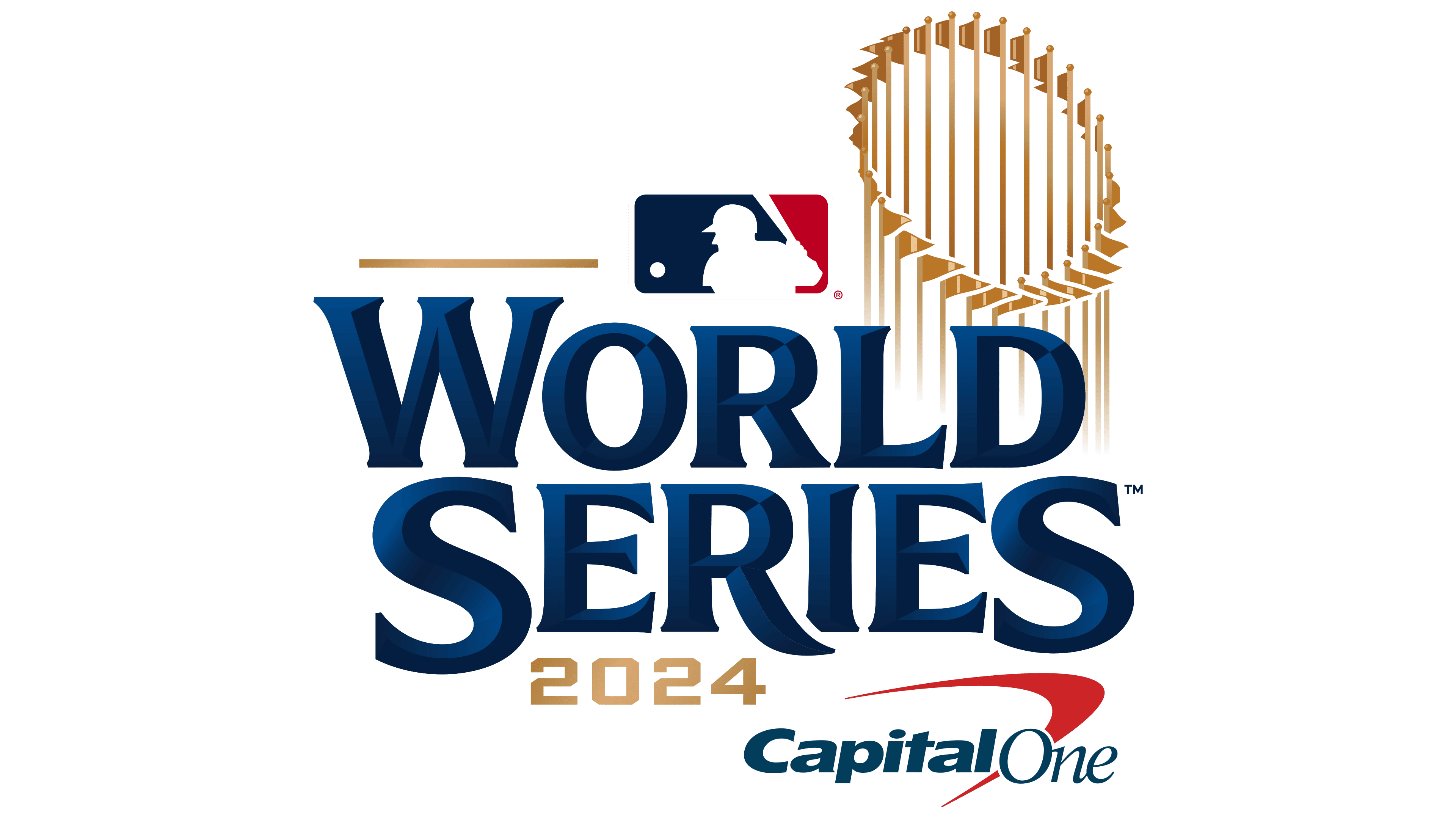
2024

The MLB World Series logo continues to use the same color palette and design style, emphasizing the tournament’s prestige and exclusivity. The inscription “World Series,” rendered in a voluminous, serifed font in a rich blue, adds depth and solidity. The Commissioner’s Trophy, depicted in gold shades on the right, adds majesty and symbolizes the reward the teams are fighting for.
Details such as the neatly inscribed date “2024” in gold under the name visually connect the parts of the logo, creating a harmonious whole. The MLB emblem and the “CapitalOne” sponsorship brand underscore the relevance of the partnership and commercial support for the tournament. The design is carefully calibrated to highlight the championship’s traditions while integrating modern design approaches.