


 FlipaClip Logo PNG
The FlipaClip logo highlights the app’s creative yet simple approach to animation. Its graphic design symbolizes the tool’s accessibility and clarity, intended for a wide user audience.
FlipaClip began in Miami in 2010, when brothers Jonathan and Marcos Meson founded Visual Blasters LLC. The idea grew out of a Samsung contest tied to the Galaxy Note and its stylus, which encouraged developers to create software suited to drawing and creative work. The first FlipaClip release arrived on Android in April 2012, bringing traditional frame-by-frame animation to mobile devices with a beginner-friendly interface.
Growth accelerated in 2014 when the app was preinstalled on 400,000 Fuhu tablets for children. The deal placed FlipaClip in front of a large young audience without requiring users to search for it. In 2017, the company launched an iOS version, widening access to Apple devices. Teenagers increasingly shared animations made with the app on YouTube and TikTok, turning user-created videos into a major source of organic exposure.
In 2018, Visual Blasters expanded FlipaClip to Windows and macOS, giving users desktop options alongside its mobile editions. The software occupied an entry-level niche compared with professional tools such as Adobe Animate, while keeping its focus on accessible frame-by-frame creation.
By 2025, FlipaClip had passed 100 million downloads. Google Play repeatedly featured it in creative-app collections, helping its visibility and expanding its audience worldwide. In 2024, the company faced a user-data breach, notified users, and took steps to address the security issue while continuing development of the animation platform.
Meaning and History
What is FlipaClip?
It is a popular app for creating frame-by-frame animation on smartphones and tablets, replicating the traditional hand-drawn animation style. This allows users to produce cartoons and video clips. Key features include layers, adjustable frame rates, and sound integration.
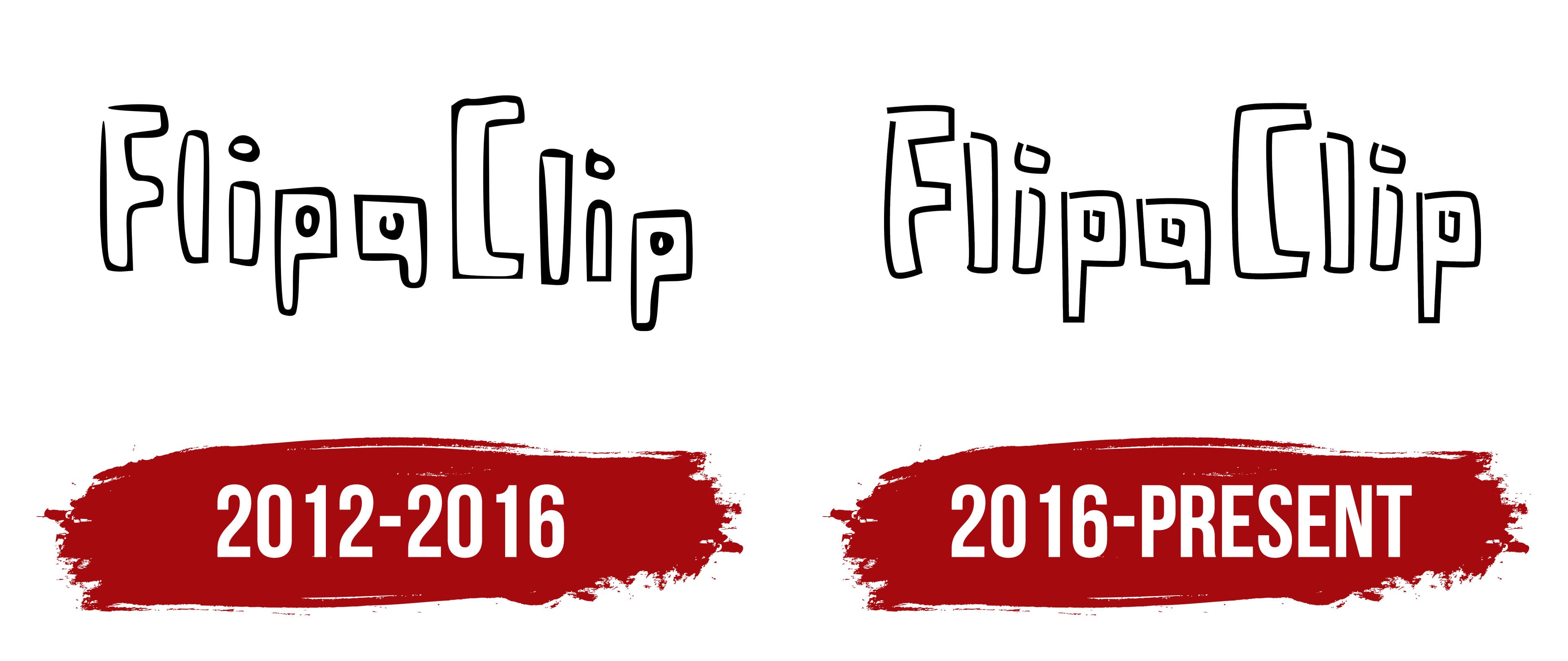
2012 – 2016

The FlipaClip logo from 2012–2016 is from the early stage of the mobile application’s existence. Created by Visual Blasters LLC for frame-by-frame 2D animation, it accompanied the app at launch and during its initial rise in popularity among young audiences and amateur artists.
The logo design is based on a handwritten style reminiscent of comic book illustrations, sketches, or marker lettering. The word “FlipaClip” is written in a mix of uppercase and lowercase letters with soft, uneven lines, asymmetrical shapes, and the look of hand-drawn writing. This approach was chosen to convey the atmosphere of the creative process, sketching, and the ease of making animations on a mobile device.
The custom typeface evokes a hand-drawn sketch, with irregular outlines, smooth curves, and a lack of strict geometry, highlighting the brand’s informal, creative nature. The black color provides maximum contrast against the app’s white interface background.
Aesthetically, the logo design aligns with the app’s interface, featuring a white working canvas and tools that imitate pencil and ink strokes. This strengthens the brand’s association with animation and artistic techniques.
The logo was created in-house by the Visual Blasters team without outside agency involvement, as the project was a small startup with a minimal team.
With this visual style, FlipaClip first gained wide recognition in the Google Play and App Store marketplaces, began building its user community, and became a popular tool among beginner animators and bloggers creating videos and challenges for YouTube and social media.
2016 – today
The current FlipaClip logo is a continuation and development of the app’s early identity. It retains the overall hand-drawn concept but modifies the letter styling and visual accents to enhance digital adaptability and expressiveness.
The updated logo is based on a slightly modified yet similar custom typeface, in which each letter of “FlipaClip” is depicted in an unconventional, asymmetrical form reminiscent of marker sketches. The letters are vertically elongated, with varying proportions, uneven outlines, and visually dynamic lines that create an impression of lively, free movement and spontaneous creativity.
The letterforms have consistent stroke thickness and smoothly rounded corners, yet the overall shapes remain irregular and unstructured. The contours resemble artistic doodles, typically created during the animation sketching process. Letters lean in different directions, reinforcing the sense of freedom and a playful atmosphere.
The color palette is monochrome, using solid black as a universal base. Black was chosen to emphasize the tool’s clarity and neutrality, offering a space for the user’s expression without dictating a specific style.
The letter shapes do not replicate any existing font and were designed in-house by Visual Blasters LLC. They highlight the app’s individuality, setting it apart from competitors that use more technological and geometric typefaces.
Visually, this logo has become a key component of the app’s social media promotion, appearing in posts by popular creators on YouTube, Instagram, and TikTok. It emphasizes FlipaClip’s creative nature as an application for producing short-form animations, such as memes, sketches, and viral content.
Font and Colors
The typeface is a custom design in a handwritten lettering style with irregular lines and free-form shapes. The characters lack strict geometry and are fully asymmetrical, with shifting angles and varying stroke thickness, creating the effect of a live sketch made with a pen or marker. Among commercial fonts, it is most similar to AZ Dude and WhyFont.
The logo’s palette is minimalist, black on a white background. This straightforward monochrome approach ensures excellent legibility and visual neutrality, which are important for a platform focused on bright, colorful user-generated creativity.