 Jardine Cycle and Carriage Logo PNG
The automotive market and investment projects in Southeast Asia require an understanding of local conditions and long-term planning. Companies in this sector focus on business development, asset management, and partnership projects. The Jardine Cycle and Carriage logo is associated with a holding company that operates in the automotive business and investments in the region, managing companies and capital.
Jardine Cycle and Carriage was founded in 1899 in Singapore as a subsidiary of the British conglomerate Jardine Matheson. This conglomerate has operated in Asia since 1832. At the beginning of its operations, the company sold bicycles. By the 1910s, it had become one of the region’s first distributors of Austin and Morris automobiles.
In the 1920s and 1930s, Jardine Cycle and Carriage expanded its car dealership network in Malaya. The company began importing automobiles from American brands Ford and Chevrolet. During World War II, it suspended operations. In 1945, it resumed operations.
After Malaya gained independence in 1957 and Singapore in 1965, the regional market began to grow. The company became the largest car dealer in both countries and received distribution rights for Nissan and Mazda vehicles. In 1969, it was listed on the Singapore Stock Exchange.
In the 1970s, Jardine Cycle and Carriage diversified its business. The company invested in real estate and agriculture, including palm oil plantations. In 1980, it acquired a controlling stake in Indonesia’s Astra International, which distributed Toyota, Daihatsu, and Isuzu brands.
By the 1990s, Astra had become the largest Toyota vehicle manufacturer outside Japan. The 1997 and 1998 financial crises sharply reduced sales. In 1999, a restructuring enabled the business to survive. From 2000 to 2005, a new growth phase began, and Jardine Cycle and Carriage strengthened its position in Indonesia.
By 2010, car sales in the country exceeded 700,000 units. Astra accounted for about half of this volume. In 2015, the company expanded its financial services division. In 2017, it increased its stake in Astra to a controlling level.
In 2019, the company invested in the agricultural sector through Astra Agro Lestari, Indonesia’s largest palm oil producer. Since 2021, the company has begun investing in the electric vehicle sector. In 2022, construction began on an electric-vehicle assembly plant on Java.
In 2023, Jardine Cycle and Carriage entered the markets of Vietnam and Myanmar. In 2024, the company launched digital platforms for online car sales.
The company controls the region’s largest automaker, Astra International. It manages car dealerships, financial services, and agribusinesses across Southeast Asia.
Meaning and History
What is Jardine Cycle and Carriage?
A Singapore-based investment group that is part of an international conglomerate and operates in Southeast Asian markets across the automotive, financial, agricultural, and real estate sectors. The Chua brothers founded it in Kuala Lumpur and later transformed it into Cycle & Carriage, becoming the region’s first Mercedes-Benz partner. Key assets include a stake in Indonesia’s Astra International, which distributes vehicles from leading manufacturers and participates in infrastructure projects. It also holds a stake in Vietnam’s THACO, a vehicle manufacturer and property developer.
1900s – 2004

The name Cycle & Carriage means “Bicycles and Carriages.” The Chua brothers adopted it on June 15, 1899, when they entered the transportation trade. They opened their business in Kuala Lumpur earlier that year as Federal Stores. It initially sold nutmeg and household goods, followed by bicycles and carriages. They later added motorcycles and automobiles to the product range. The company kept the Cycle & Carriage name to honor its early years.
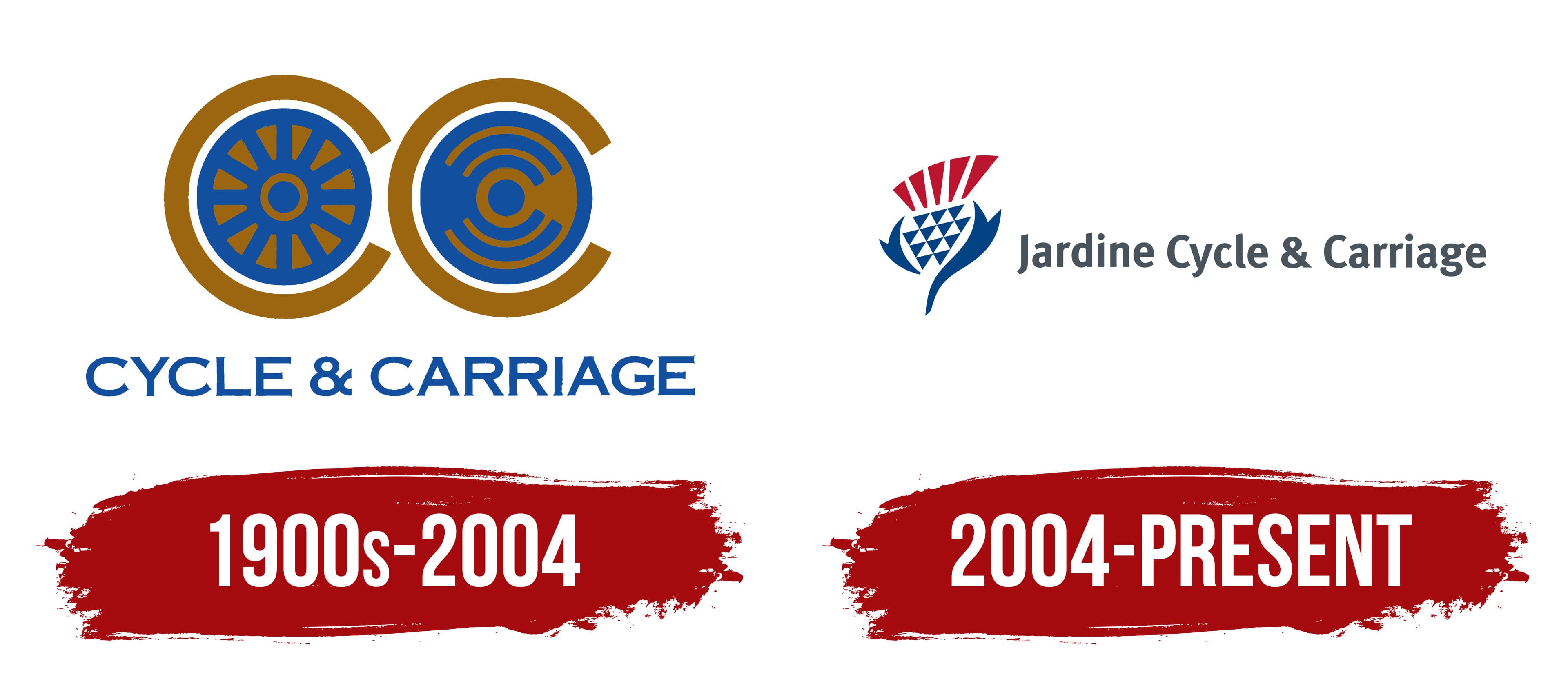
Before becoming Jardine Cycle & Carriage, the company used an emblem featuring two wheels above a wordmark. The outer edges of both circular forms consisted of large gold-colored “C” shapes with openings on the right. They referred to the abbreviation “C&C.” Inside were blue fields with bronze-gold outlines and details. The shared circular form connected the two parts of the emblem, while the interior wheel patterns differed.
The left side depicted a wheel with a hub and spokes. Gold-colored wedge-shaped sections extended from a closed circle in the center and spread across the blue disk. The right wheel consisted of concentric circles and arcs sharing a common center and repeating the shape of the letter “C.” A gold-colored ring with a blue circle inside occupied the center. A triangle was attached to the ring on the right, with its point facing left. Beneath the wheels was the blue inscription “CYCLE & CARRIAGE,” set in uppercase letters. The full name explained the emblem’s connection with the transportation trade.
The company’s legal status changed as the business grew. In 1918, it was incorporated as a limited liability company in the Federated Malay States. In 1926, The Cycle & Carriage Company (1926) Limited became a public company in Singapore. Automobile sales became its primary business during the following decades.
Cycle & Carriage obtained the Mercedes-Benz franchise in 1951 and became the brand’s first representative in Southeast Asia. In 1965, it produced the first locally assembled Mercedes-Benz at its Singapore facility. Cycle & Carriage Limited was listed on the stock exchanges of Malaysia and Singapore in 1969. The company later referred to its earlier emblem as part of its brand history under the name “two-wheel logo.”
2004 – today

The name Jardine Cycle & Carriage appeared after several stages of the company’s integration into Jardine Matheson Group. Jardine acquired its first stake in Cycle & Carriage in 1992 and later increased its ownership interest. The company became a subsidiary of the group in 2002. On January 5, 2004, it changed its legal name from Cycle & Carriage Limited to Jardine Cycle & Carriage Limited. The word “Jardine” identified the owner. The “Cycle & Carriage” portion preserved the historic brand adopted in 1899 and maintained a connection with the company’s 104-year history.
The corporate logo changed along with the name. The two-wheel emblem was replaced by the Jardines thistle, indicating that the investment holding company belonged to the parent group. The flower referred to Scotland, the homeland of Jardine Matheson founders William Jardine and James Matheson. Landor Associates developed its geometric form in 1982 as part of the group’s identity, 22 years before Cycle & Carriage was renamed.
The emblem combines a dark blue lower section with a red top. The center of the flower consists of a solid blue form containing rows of white triangles with their points facing upward. At the bottom, it extends into a curved stem. Two elongated blue sections rise along the sides, framing the center. Above them, five rich crimson-red petals spread outward in a fan. The petals widen toward the top and lean in different directions.
The dark gray “Jardine Cycle & Carriage” wordmark appears on the right. The words begin with capital letters followed by lowercase letters, and an ampersand connects “Cycle” and “Carriage.” The name is set in a sans-serif typeface with medium-weight strokes, rounded forms, and even outlines. The wordmark and thistle form the parent company’s horizontal logo.
Automotive businesses in Singapore, Malaysia, and other regions continued operating under the Cycle & Carriage name with the “C&C Wheels Logo.” The two wheel forms represented the automotive business, while the full name containing “Jardine” and the thistle belonged to the investment holding company. These distinct identities separated the parent organization from the automotive companies.
The wheel logo was redesigned in 2017 while retaining its two circular forms. Management linked the update to an effort to give the historic emblem a contemporary look. The next stage involved work on the “Exceptional Journeys” brand platform. During 2017 and 2018, the Cycle & Carriage team gathered feedback from customers, employees, and partners. The company unveiled the platform in January 2019 during its 120th anniversary celebration.